

Here's something that happens more often than most agencies admit.
Two companies come to us in the same month. Similar products - B2B SaaS, solving a workflow problem, targeting mid-market teams. Similar budgets.
Both get a 60-second animated explainer. Six months later, one video has become the anchor of their sales deck, their homepage hero, and the thing their SDRs drop into every cold email.
The other is buried in a Google Drive folder nobody opens.
Despite following the same format and same duration, they get wildly different outcomes.
No, it's not luck. And it's not about which agency you hired or which animation style you chose.
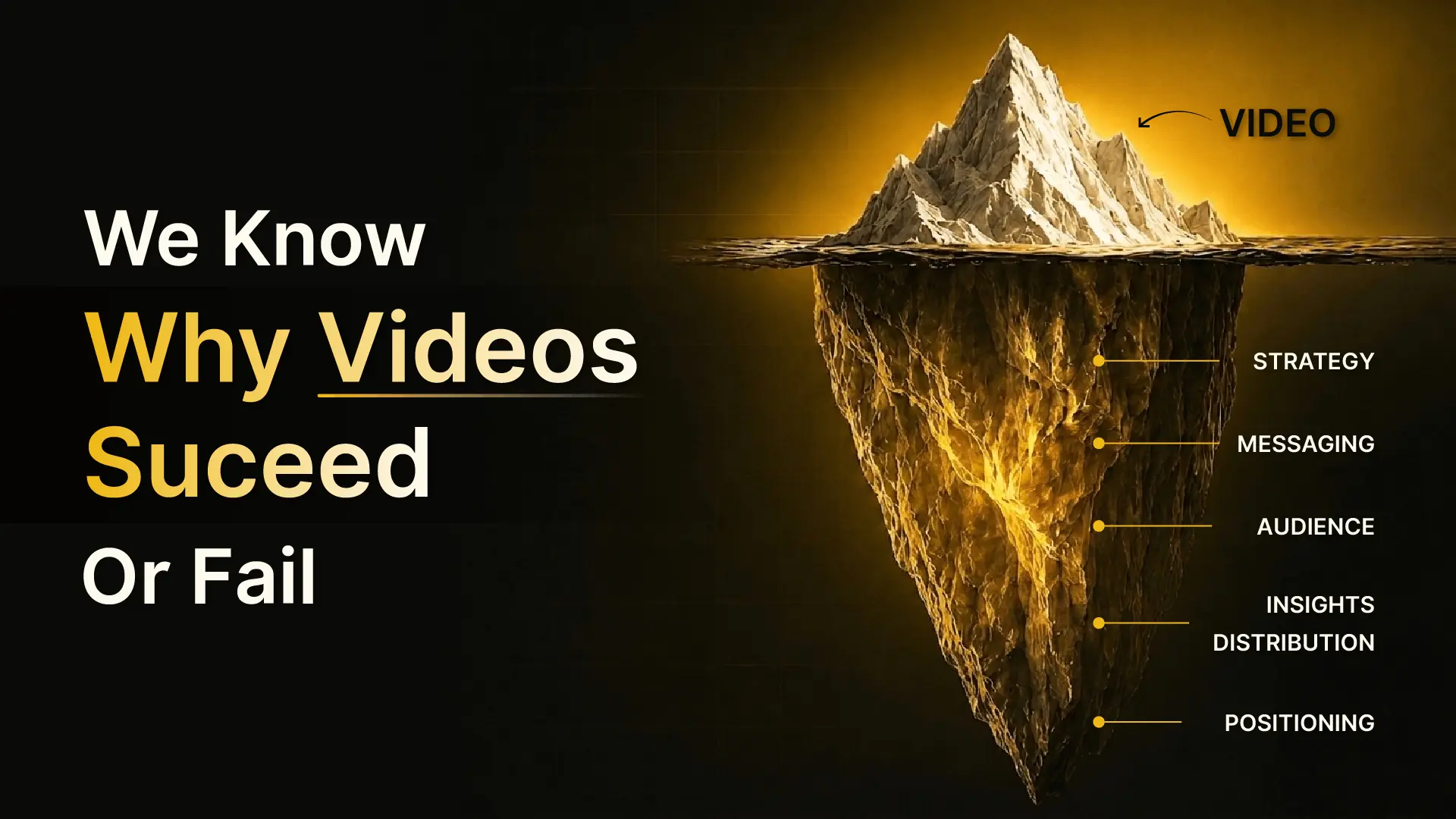
It almost always comes down to decisions made before a single frame was designed. Decisions about message, structure, and intent.
We’ve worked with 650+ SaaS and tech brands, and produced 1,200+ videos. We've seen both sides of this equation so many times that the patterns are impossible to miss.
This piece is our honest account of both.
The State of Business Video in 2026
Let's start with context, because the landscape has shifted in ways that matter.
According to Wyzowl's State of Video Marketing 2026, 91% of businesses now use video as a marketing tool. That number has sat near a ceiling for three consecutive years.
That tells you video is no longer a differentiator by virtue of existing. Everyone has a video. The question is whether yours is working.
Here's the stat that should concern every marketing team: overall ROI satisfaction from video marketing dropped from 93% in 2025 to 82% in 2026.
Videos didn’t stop working but the volume of average content flooded every channel simultaneously.
Since AI tools democratized production, it's good for speed but not always great for quality.
The brands winning in this environment aren't the ones making more videos. They're the ones making the right video.
Those built on a clear brief, a focused message, and an honest understanding of who they're talking to.
The competitive advantage from just having a video is gone. The advantage now belongs to brands that understand why their video will work before it's made.
What Makes a Business Video Actually Work
.webp)
Before we get to failure patterns, it's worth being precise about what success looks like. Because it's less about aesthetics than most people expect.
It leads with the problem, not the product. Effective videos open in the viewer's world. A frustration they recognize, a situation they've lived in.
The product enters as a resolution, not an introduction. This sequencing is simple but violated constantly.
It has one message, executed completely. The best explainer videos are ruthlessly focused. Not "here's everything our platform does" but "Here's the one thing that will change how your team works, and here's exactly how." Everything else is noise.
The script is the strategy. Visuals execute what a script decides. A beautiful video with a confused script produces a beautiful video that doesn't convert.
The script determines the structure, the emotional arc, the clarity of the value proposition, and the action the viewer takes at the end. Every other production decision should serve what the script has already established.
Visual language matches the complexity of the idea. Animation works exceptionally well for abstract concepts, workflows, and software products that can't be "shown" in the real world.
Live action works when human connection, culture, or physical context matters. Mismatching these creates friction that eventually costs you attention.
It ends with a specific action, not a suggestion. A generic ‘Learn more’ is not a call to action. It's a shrug.
A strong video close tells the viewer exactly what to do next and makes it feel like the natural next step rather than a sales push.
Why Business Videos Fail: The Patterns We Keep Seeing
.webp)
Most video failures are quiet. The video goes live, gets some early plays from the team, and then slowly drifts into irrelevance.
Here's why:
1. They Start With the Product, Not the Problem
This is the most common mistake we see, and it happens because the people closest to the product want to show it off immediately. Understandable. Wrong.
Buyers don't connect with products first. They connect with problems. The first five seconds of a video are when a viewer decides whether what they're watching is for them.
If those five seconds open with a logo animation and a feature list, most viewers are already gone mentally - even if they keep the tab open.
The video that works opens in the viewer's Tuesday afternoon. It names something they've experienced. It earns the right to introduce a solution by first demonstrating understanding.
We've seen this pattern repeatedly across both explainer videos and product demos. When the audience doesn't immediately recognize their problem, even a well-produced demo can lose momentum before the core message lands.
2. They Try to Say Everything and Communicate Nothing
We've had clients come in with briefs that list 14 things the video needs to cover. Features, integrations, pricing model, customer success, the roadmap, the founding story.
In 90 seconds.
The result is always the same: a video that covers everything superficially and communicates nothing memorably.
One practitioner in the industry described spending $8,000 on a video that tried to explain 15 features in 90 seconds - and said, Nobody understood what we actually did.
A focused video that drives home one idea completely will always outperform a comprehensive video that grazes ten ideas.
This is one of the hardest conversations to have with founders, because the instinct to include everything comes from a real place - you've built something complex, and you're proud of all of it. But the viewer needs to be convinced of one thing first.
Everything else can come later.
One SaaS client came to us after a previous explainer failed to generate demo requests. After simplifying the message to focus on a single workflow problem, the revised video became a key asset across their homepage and sales outreach.
3. The Script Was an Afterthought
Here's how the wrong brief usually goes: a company books a production team, asks to see some visual references, picks a style they like, and then writes a script in a Google Doc over a weekend.
The production is then asked to execute a script that was never stress-tested, never pressure-checked for clarity, and never mapped to a specific viewer at a specific moment in their buying journey. Even great animation can't save a script with a muddled value proposition.
Script quality is the single biggest performance variable in any business video. Not animation style. Not voiceover quality. Not music. The script. It deserves the same rigor as a landing page copy or a pitch deck, sometimes more.
4. Wrong Style for the Content
This is a mismatch that costs time and money. A SaaS company with an entirely abstract, data-driven product chooses live action because they want it to "feel human."
A brand with a story best told through real people chooses full animation because someone showed them a reference they liked.
In both cases, the style is working against the content and viewers feel that friction without being able to name it.
The result is a video that feels slightly off in a way the client can't pinpoint and the production team can't fix in post.
Animation is ideal for workflows, software interfaces, abstract processes, and concepts that can't be physically filmed.
Live action leads when human trust, company culture, or emotional nuance is the primary message. The style question should be answered by the brief, not by the mood board.
5. The Call to Action Was Vague or Missing
The video builds perfectly. Problem established, product introduced, value demonstrated, viewer engaged. And then: Visit our website to learn more.
The viewer closes the tab.
A business video without a specific, motivated call to action is like a great sales conversation that ends with the rep saying "let me know if you have questions" instead of booking the next meeting.
The work of the video is to earn a next step. Make the next step clear, specific, and easy.
"Start your free trial." "Book a 20-minute demo." "See how [Company X] saved 12 hours a week." These work. "Learn more" doesn't.
6. It Was Built for One Platform and Deployed on All of Them
A two-minute explainer built for a homepage hero watch experience will die on LinkedIn, where the average user gives a video 7 seconds before scrolling.
A 60-second video optimized for silent mobile viewing with captions will perform very differently than the same video without them.
Platform isn't a distribution afterthought - it's a production decision. The script length, pacing, aspect ratio, caption dependency, and opening frame are all shaped by where the video will actually live and how the viewer will encounter it.
LinkedIn has surpassed YouTube as B2B's primary video channel. If your video wasn't thought about through a LinkedIn lens, it may underperform there regardless of its quality.
The brands that get the most from one production are the ones who think about this at the brief stage and plan intentional cuts for different contexts - not repurposed crops, but genuine format-native versions.
7. Production Quality Was Treated as an Aesthetic Choice, Not a Trust Signal
This one is subtle but powerful. In a market where 89% of buyers say video quality directly impacts their trust in a brand, the quality of your video is not just a reflection of your creative taste - it's a proxy for how seriously you take your own product.
A video with muddy audio, stock-footage mismatches, off-brand colors, or templated animation tells the viewer something about your standards before your message even lands.
This doesn't mean every video needs a six-figure budget. It means every video should look intentional, polished, and brand-consistent because those signals communicate credibility at a level that the content itself can't override.
We've seen enterprise buyers dismiss otherwise strong products because the video felt templated or generic. In crowded SaaS markets, production quality often influences trust before a single feature is evaluated.
The Question We Ask Every Client Before We Write a Single Word
.webp)
Before any script, before any storyboard, before any style reference is pulled, we work through a brief that anchors on four questions:
Who, specifically, is watching this video? Not "our ICP." A real person - their title, their priority this quarter, their skepticism about your category, and what they're doing five minutes before and after they encounter your video.
What do they already believe? This determines where the video has to start. You can't open by solving a problem they don't know they have.
You can't explain a concept they already understand. Meeting the viewer where they are is the only way to move them.
What is the one thing they must understand by the end? Not five things. One. If the brief lists more than one, we push back. A video that tries to accomplish multiple primary objectives will typically accomplish none of them cleanly.
What is the specific action we want them to take immediately after watching? This determines the CTA, which shapes the entire emotional arc of the script.
A video meant to drive demo bookings is structured differently than a video meant to explain a feature to existing users. The action comes first; everything else is engineered to lead there.
If you can answer these four questions with specificity and confidence, you have a brief. If you can't, the video will drift during production and underperform in the market.
A Quick Self-Audit: Is Your Video Set Up to Succeed?
If you already have a video - or you're evaluating a brief for one - run through these:
- Does the video open with a problem the viewer recognizes within the first 5 seconds?
- Is there one central message that a viewer could repeat back after one watch?
- Was the script reviewed for clarity by someone outside your company before production started?
- Does the visual style match what the product actually needs to communicate?
- Does the video end with a specific, named next action - not just a URL?
- Was the video built with its primary platform in mind from the script stage?
- Would you describe the production quality as something that represents your brand well to a skeptical enterprise buyer?
If you answered no to two or more of these, you've likely identified why the video isn't performing the way you expected.
What We'd Tell You Before You Spend a Single Dollar on Video
Invest in the brief before you invest in the production. The 2–3 hours it takes to get genuinely clear on your audience, your message, your CTA, and your platform is the highest-leverage work in the entire video production process.
It compresses revision cycles, aligns the production team from day one, and dramatically increases the likelihood that the finished video actually moves the needle.
Don't fall in love with a style before you understand the story. Watch reference videos. Get inspired. But let the brief tell you what style to choose - not the other way around.
And don't treat production quality as a budget variable to cut first. Your video is often the first or second thing a serious buyer encounters from your brand.
The impression it makes compounds. A well-produced video at the right budget is a 2–3 year asset. Divide the cost by the number of times it'll be seen, and the math almost always favors doing it properly.
We've seen videos at a third of the budget outperform videos with premium spends - because the brief was sharper, the message was cleaner, and the call to action was precise. And we've seen the inverse just as often.
The difference between a video that works and one that doesn't is almost never the animation style, the voiceover talent, or the music choice. It's the thinking that happened before any of those decisions were made.
We've helped 650+ SaaS and tech brands make that thinking count. If you want us to look at your brief - or help you build one - book 20 minutes with us here. No slides required.
Related Reading:
- The Strategic Guide to Explainer Video ROI for SaaS in 2026
- YC Startups Nail Their Launch Video. You Can Do It Too, But How?
Frequently Asked Questions
Why do business videos fail?
Business videos usually fail because they focus on features instead of customer problems, communicate too many messages, use weak scripts, or lack a clear call to action.
What makes a business video successful?
Successful business videos focus on a single message, address a specific audience problem, use the right visual format, and guide viewers toward a clear next step.
How long should a business video be?
Most SaaS and B2B explainer videos perform best between 60 and 120 seconds depending on the platform and objective.
Should SaaS companies use animation or live action?
Animation works best for abstract workflows and software concepts, while live action is often better for trust-building, culture, and customer stories.


