

Let's be honest about something the industry isn't saying clearly enough.
AI has genuinely changed what's possible in marketing content creation. The speed, volume, and cost efficiency.
A team that used to take two weeks to produce a first draft of anything can now produce five versions before lunch.
A solo founder who couldn't afford a designer can generate something that looks like design. A company with no production budget can now create functional video content.
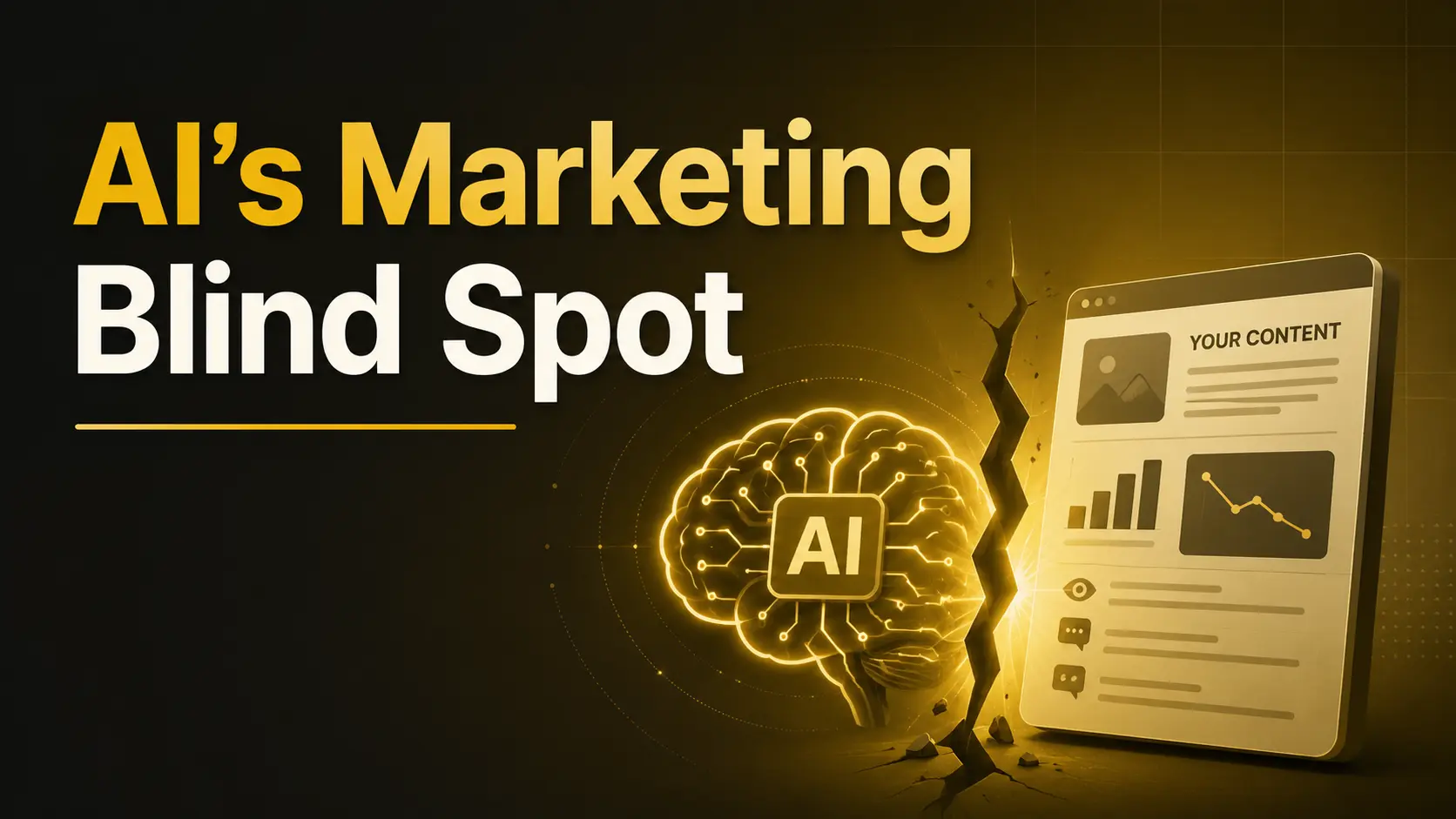
But there's a gap growing wider every quarter between content that was made with AI and content that actually works. And the companies that are winning right now are the ones that understand precisely where that gap opens up.
This isn't an argument against AI. We use AI tools in our own production work at What a Story. The argument is more specific: AI breaks in very particular places when applied to marketing content and those breaks are predictable enough to plan around.
Here's where they happen, why they happen, and what actually fixes them.
If You're In a Hurry, Here's The Reality
The companies getting the best results from AI aren't replacing human expertise. They're using AI to accelerate execution while keeping strategy, buyer understanding, and creative decision-making firmly in human hands.
The Core Problem Nobody Wants to Name
AI tools are trained on what exists. They are extraordinarily good at producing competent, recognisable, pattern-consistent output. That is also their fundamental limitation as marketing tools.
Marketing works through differentiation. The content that stops someone scrolling, that makes a buyer feel seen, that makes a brand feel distinct from every other brand in its category.
Such content, by definition, cannot be produced by a system trained on what already existed. It can approximate it. It can produce something adjacent to it. It can remix originality. It rarely produces strategically differentiated ideas.
Every specific failure mode below is a manifestation of this core problem.
Where AI Breaks in Design
The generic aesthetic problem
Open any AI image generation tool and ask it for "a professional SaaS marketing image." You will receive something that looks exactly like every other SaaS marketing image: Abstract geometric shapes suggesting connectivity, a blue-to-purple gradient, clean sans-serif typography, perhaps a hand holding a phone or a dashboard floating in space.
It is immediately recognisable as a type of image. It is not recognizable as your brand.
In a competitive market, looking like everything else is indistinguishable from being invisible.
We’ve already started seeing this in SaaS categories where AI-generated visuals have made multiple competitors look visually interchangeable. The production quality improved. The distinctiveness disappeared.
The contrast becomes obvious when you look at SaaS videos that have developed a genuinely distinctive brand voice and visual identity.
For example, look at a typical AI-generated SaaS homepage hero today. Across dozens of companies, you'll see remarkably similar visual patterns: floating dashboards, abstract gradients, generic workflow diagrams, and identical efficiency imagery.
The execution quality is often high. The problem is that buyers struggle to remember which company they just looked at because the visual language has become nearly interchangeable.
The fix: Use AI for ideation and iteration, not for final output. Let it generate twenty directions in twenty minutes.
Use those directions as raw material for a human designer who can identify which direction is actually on-brand, unexpected, and specific enough to work for your particular audience.
The brand consistency collapse
Ask the same tool to produce three variations of a brand graphic and you will get three graphics that are loosely similar in style but inconsistent in the specifics that actually define a brand: exact colour values, typography weight and spacing, illustration character proportions, line weight, corner radius.
At a small scale, this is barely noticeable. At the scale most companies now produce AI-assisted content (dozens of social posts, multiple landing page variants, video thumbnails, ad creatives) the inconsistency compounds.
A brand that looked coherent at a hundred touchpoints starts to look like several different companies at a thousand.
The fix: Human-maintained design systems are not optional at scale. The design system that consists of colour tokens, typography rules, component library, illustration guidelines, logo usage must be documented specifically enough that AI output can be evaluated against it, not generated from scratch each time.
Every AI-generated piece of design should be checked against the design system before it goes anywhere near a customer.
The context blindness problem
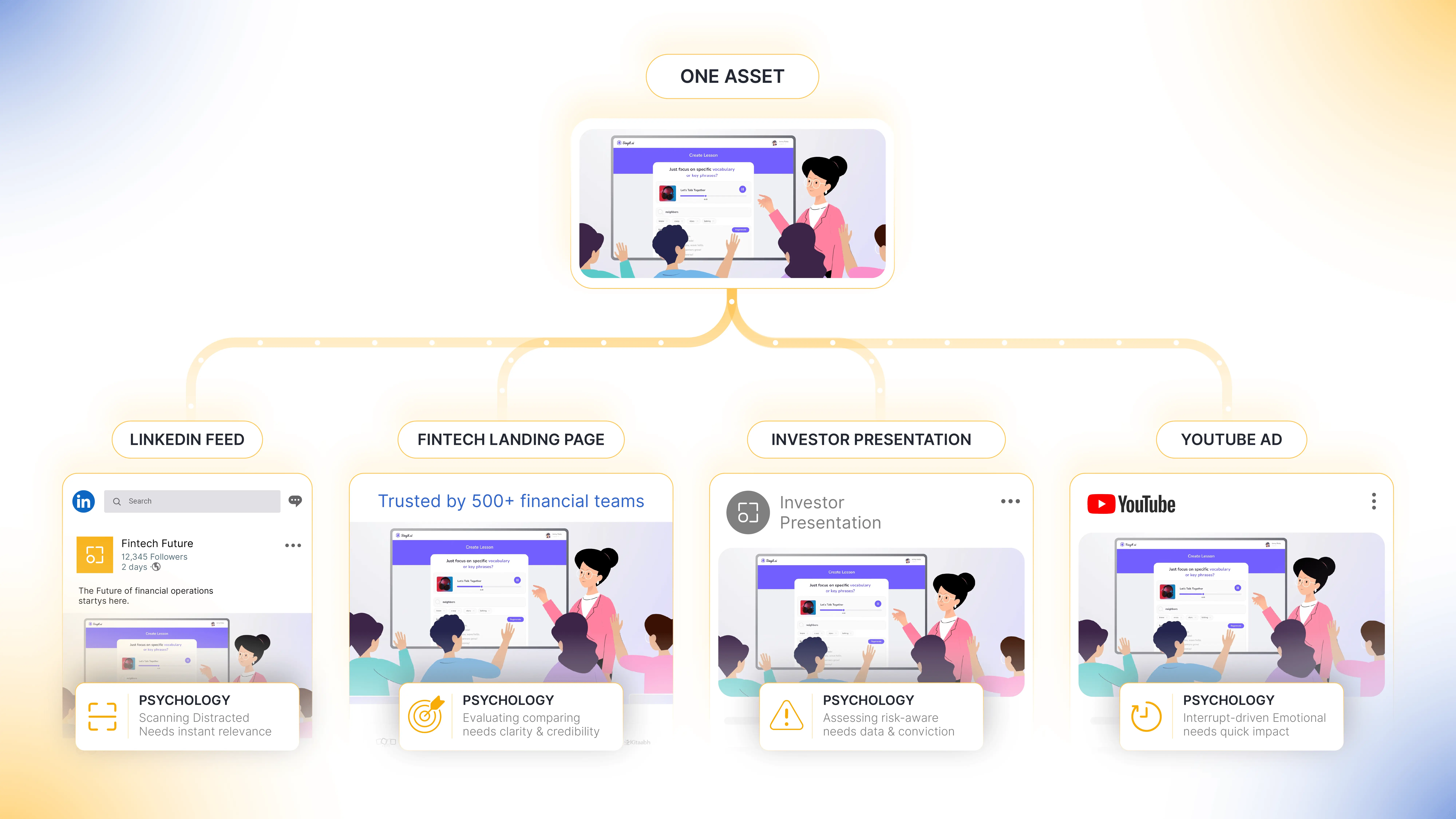
AI design tools don't know what the image is for. They don't know whether it's going to appear at the top of a landing page designed to convert a fintech CFO, or in a LinkedIn feed between a news article and a competitor's post.
They don't know what the viewer will have just seen before they see this image, or what the viewer needs to feel in order to take the action the image is supposed to support.
This produces a design that is technically competent and contextually useless.
The fix: Brief the design as specifically as you brief the copy. Where will this appear? Who will see it? What have they just looked at? What do you need them to feel? What do you need them to do?
An AI tool given a specific strategic context produces better output than one given a generic prompt. And a human designer given that same context produces something the AI cannot.
Where AI Breaks in Video
The authenticity problem
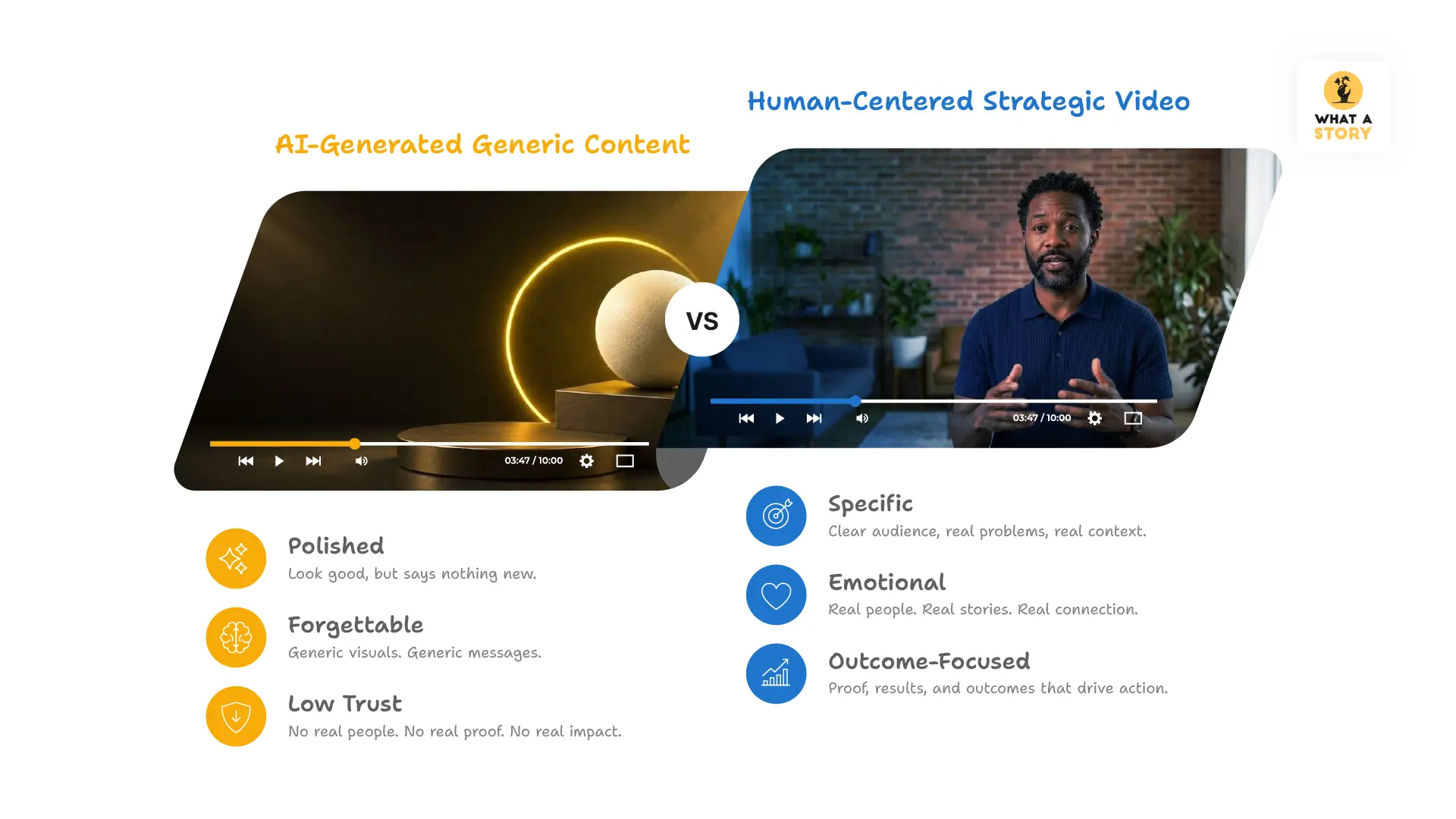
AI-generated video whether fully synthetic or AI-assisted has a tell. As of 2026, most viewers can't articulate what it is.
They register it as a feeling: something slightly off, slightly plastic, slightly too smooth. Motion that doesn't quite correspond to how real motion feels. Faces that are technically correct and somehow wrong.
In marketing contexts, that feeling is fatal. Because the thing marketing video needs to build, above everything else, is trust. And trust is extraordinarily sensitive to authenticity signals.
A viewer who registers that something is slightly off becomes a viewer who slightly doesn't trust the brand. Slightly not trust is enough to not convert.
The fix: AI-generated video works best in contexts where authenticity is not the primary requirement like background footage, abstract sequences, data visualisation, transitions.
For any video that requires a human face, a genuine environment, or an emotional performance, the authenticity requirement overrides the efficiency argument.
The Script Mediocrity Problem
This is the most consequential AI failure in video production and the most widely underestimated.
AI can produce a video script that is structurally correct. It will have something that resembles a hook.
It will introduce something that resembles a problem. It will present something that resembles a solution. It will end with something that resembles a CTA.
What it will not produce and cannot produce is a script whose opening line makes a specific viewer stop and think: that is exactly the thing I said to my manager last Tuesday.
Consider two opening lines:
AI-generated version: "Managing projects efficiently can be challenging for growing teams."
Buyer-aware version: "Your sales team closed the deal, but three weeks later the customer is still waiting for implementation to start."
Both are technically correct. Only one sounds like it came from someone who understands the buyer's reality.
This is also why strong B2B video scripts are built around buyer insight rather than product messaging alone.
That difference is often what determines whether a viewer keeps watching or scrolls away.
That level of specificity requires knowing the viewer in a way that no language model knows them. It requires having read hundreds of their Reddit posts and G2 reviews and Slack complaints.
It requires pattern recognition built from watching what hundreds of similar viewers responded to and what they ignored.
It requires the kind of editorial judgment that decides not just what to say, but which thing to say first, and why that thing and not the twenty other true things that could have gone there.
The fix: Use AI for script drafting and iteration, not for script strategy. Let it generate five versions of a section quickly.
Use those as material for a human strategist who can identify which version is closest to the truth of the buyer's situation and rewrite from there.
The generation is fast. Judgment is the job.
The Taste Problem
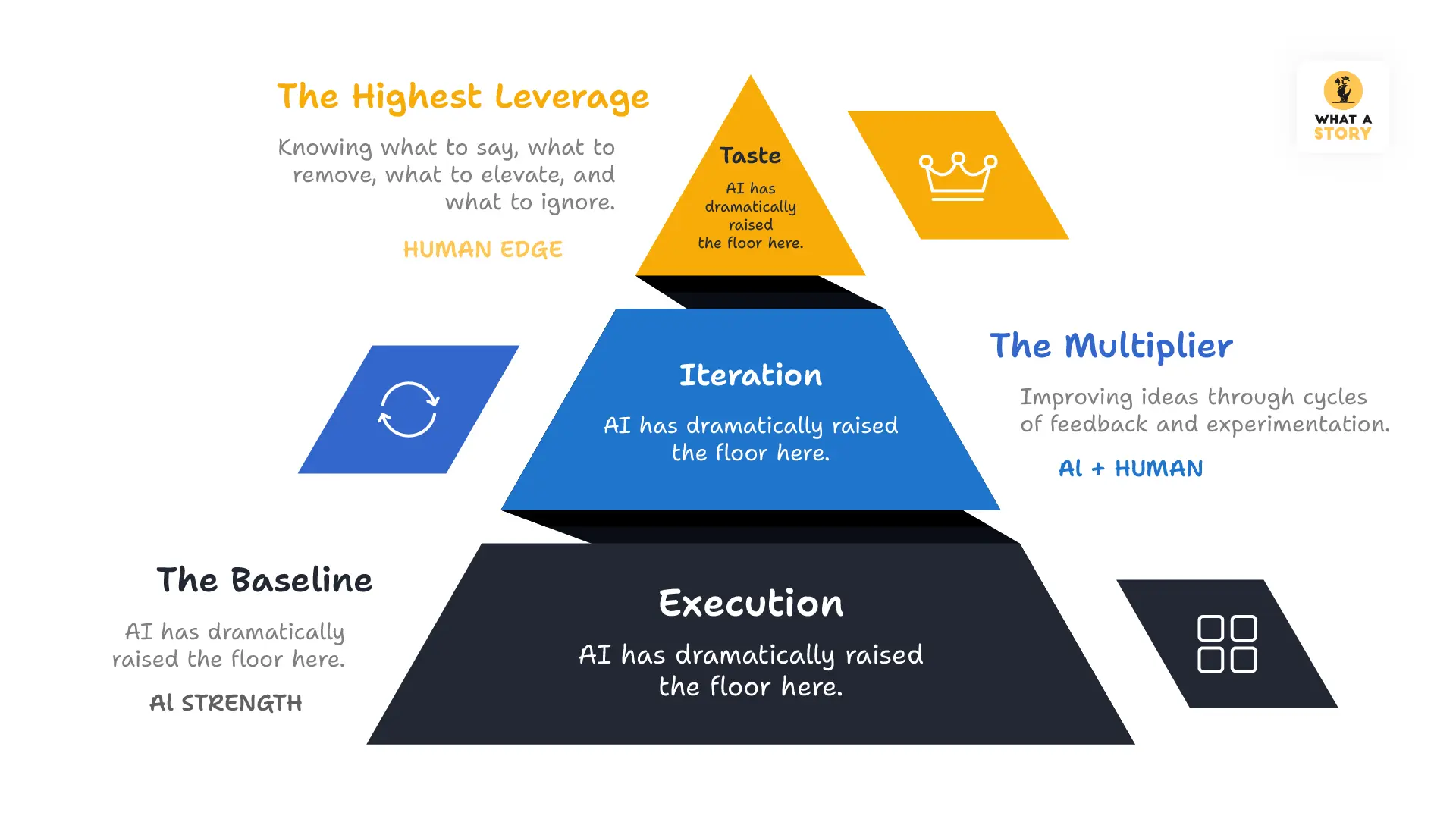
This may be the most important limitation of AI in marketing.
AI has dramatically raised the baseline quality of content. Clean visuals, acceptable copy, decent editing, polished motion graphics. What used to look amateur now looks competent.
But when everyone can produce competent content, competence stops being a competitive advantage.
The real advantage becomes taste.
In B2B marketing, that often means knowing which message deserves attention and which ideas should be left out.
Taste is knowing which idea deserves attention and which should be abandoned.
Taste is knowing when a message is too broad, when a visual is overdesigned, or when a buyer needs simplicity instead of more information.
AI can generate thousands of options.
It cannot reliably tell you which one actually matters.
The difference becomes obvious when you look at successful AI product marketing. The best AI explainer videos aren't winning because they use AI. They're winning because they communicate a clear problem, a specific audience need, and a compelling story.
As more brands gain access to the same tools, creative restraint, editorial clarity, and category understanding become more valuable, not less.
The companies that stand out will not be the ones producing the most content. They will be the ones making better decisions about what deserves to exist in the first place.
The Framework: Where AI Helps and Where It Doesn't
After working across hundreds of marketing video and content projects at What a Story, here is the honest map:
The companies getting the most from AI in their marketing content are using it to move faster on execution while investing more in the strategic and creative judgment that execution is supposed to serve.
The companies getting the least from it are using it to replace that judgment entirely and producing content that is fast, cheap, and indistinguishable from every other fast, cheap content in their category.
In Conclusion
AI has largely solved the execution problem. It can draft, generate, iterate, and produce content at a scale that was impossible only a few years ago.
What it hasn't solved is judgment.
The challenge for modern marketing teams is no longer producing more content. It is deciding what deserves to be produced in the first place.
The brands that win with AI won't be the ones generating the most assets.
They'll be the ones combining AI's speed with human insight, buyer understanding, creative restraint, and strategic thinking.
Because execution is becoming cheaper every day. Judgment is becoming more valuable.
Using AI But Not Seeing Better Marketing Results?
AI can help you create more content. It doesn't automatically help you create content that converts.
At What a Story, we combine AI-assisted workflows with human-led strategy, buyer research, scripting, and creative direction to help SaaS and B2B brands produce videos that are specific, credible, and built around real customer insights.
Explore our work and see how strategic video content drives results.