


Anyone can explain a SaaS product in a one-to-one conversation. The real challenge begins when your business starts to scale.
As your customer base grows, the same product story needs to reach hundreds or thousands of prospects across marketing campaigns, sales conversations, onboarding, and customer success. Every buyer expects to understand how your software solves their problem before committing to a demo or free trial.
This is where B2B SaaS video marketing becomes a growth driver rather than just another marketing tactic. Well-planned videos help explain complex products, educate buyers, shorten sales cycles, improve product adoption, and support customer retention - all while delivering a consistent message at every stage of the customer journey.
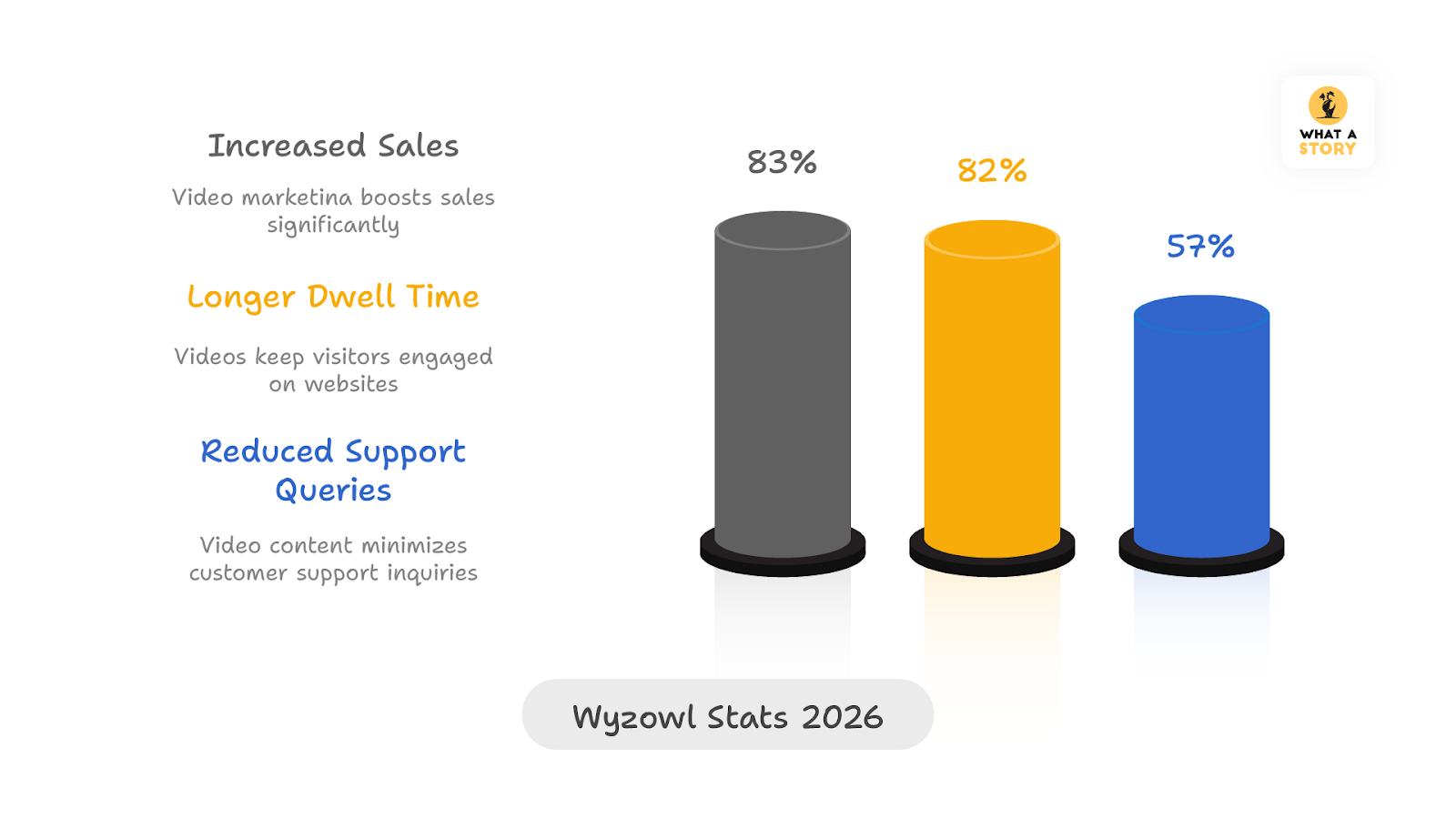
The business impact is significant. According to Wyzowl's latest Video Marketing Statistics, 83% of marketers say video has directly increased sales, 82% report longer website engagement, and 69% say video has helped reduce customer support requests. For SaaS companies, these outcomes influence everything from pipeline growth to customer lifetime value.
This is because video allows scaling SaaS companies to turn their best pitch into repeatable assets. It transforms complex workflows into clear narratives, aligns marketing, sales, and product around a single story and creates trust at a distance when founders are no longer on every call.
This guide explains how B2B SaaS companies can use video throughout the entire customer lifecycle - from awareness and evaluation to onboarding, expansion, and retention.
It also covers how to build a scalable SaaS video marketing strategy, choose the right video formats, distribute them effectively, and measure their business impact.
What Is B2B SaaS Video Marketing?
B2B SaaS video marketing is the strategic use of video to educate buyers, demonstrate software, accelerate sales, onboard customers, and improve product adoption throughout the customer lifecycle.
Unlike traditional B2B marketing, SaaS companies are not selling a one-time purchase. They are selling an ongoing product experience where customer success directly influences recurring revenue.
That difference changes the role video plays.
Instead of focusing only on awareness campaigns, SaaS companies use videos across every stage of growth.
- Marketing teams use explainer videos to communicate positioning.
- Sales teams use product demos and customer stories to reduce objections.
- Customer success teams use onboarding and tutorial videos to reduce support tickets.
- Product teams use release videos to introduce new features.
- Leadership teams use thought leadership videos to build authority in the market.
The result is a connected video ecosystem that supports acquisition, activation, retention, and expansion instead of isolated marketing campaigns.
B2B Video Marketing vs B2C Video Marketing
Although both rely on visual storytelling, their objectives are fundamentally different.
A consumer may buy a product after watching a 30-second advertisement.
A SaaS buyer often needs multiple videos over weeks or even months before making a purchase. Different stakeholders require different information, and each video should help move the buying process forward.
Why SaaS Companies Invest in Video
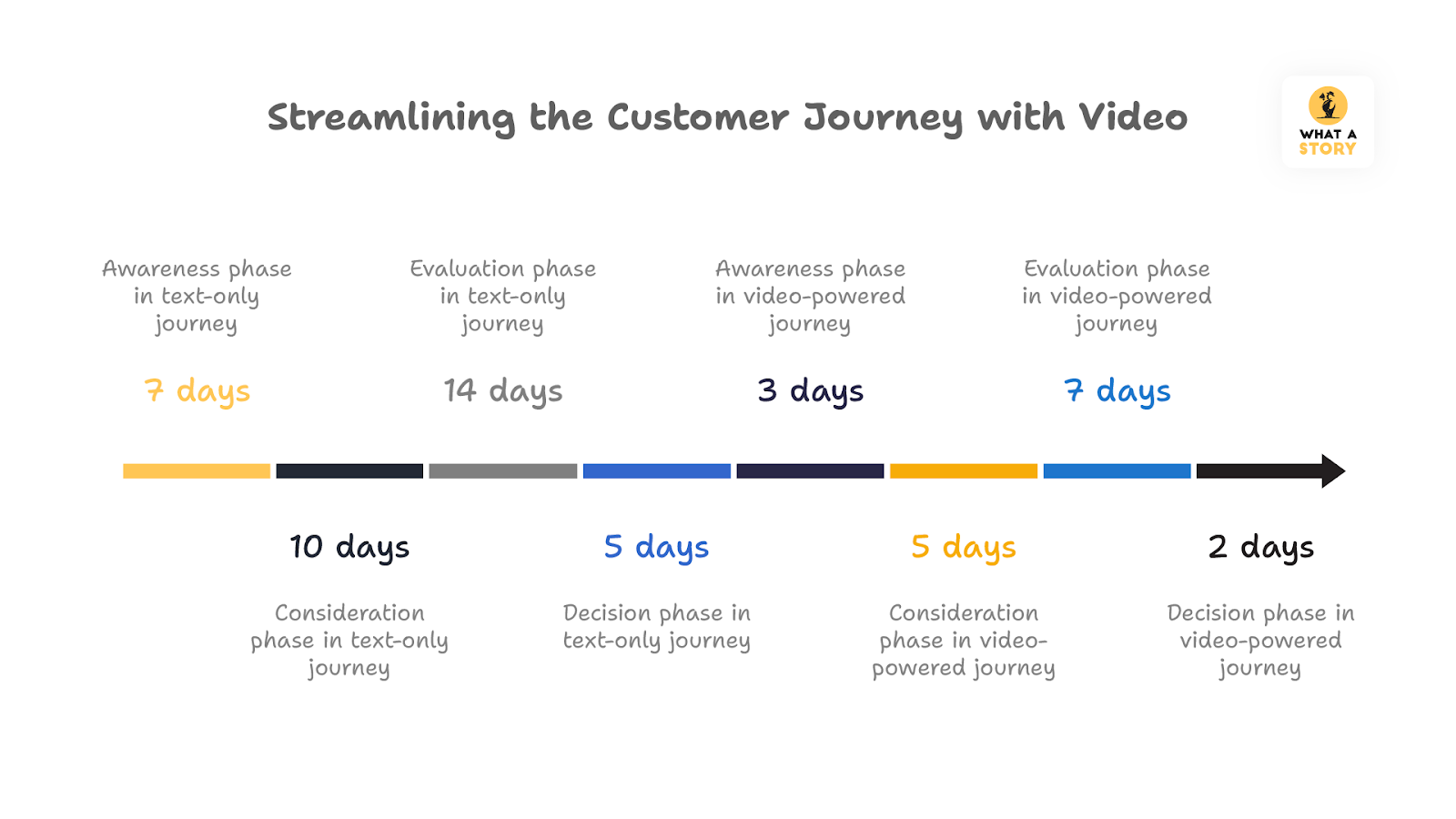
1. It shortens sales cycles drastically
Enterprise SaaS purchases rarely happen after a single conversation.
Prospects compare multiple vendors, involve different stakeholders, evaluate integrations, review security requirements, and calculate return on investment before making a decision.
Without video, sales teams often repeat the same product explanations in every meeting.
Video changes that.
A well-produced explainer or product demo answers common questions before the first sales conversation, allowing prospects to understand the product on their own schedule.
Instead of spending discovery calls explaining basic functionality, sales representatives can focus on solving customer-specific challenges.
For growing SaaS companies, this creates a more efficient sales process while improving consistency across every conversation.
2. It improves product understanding
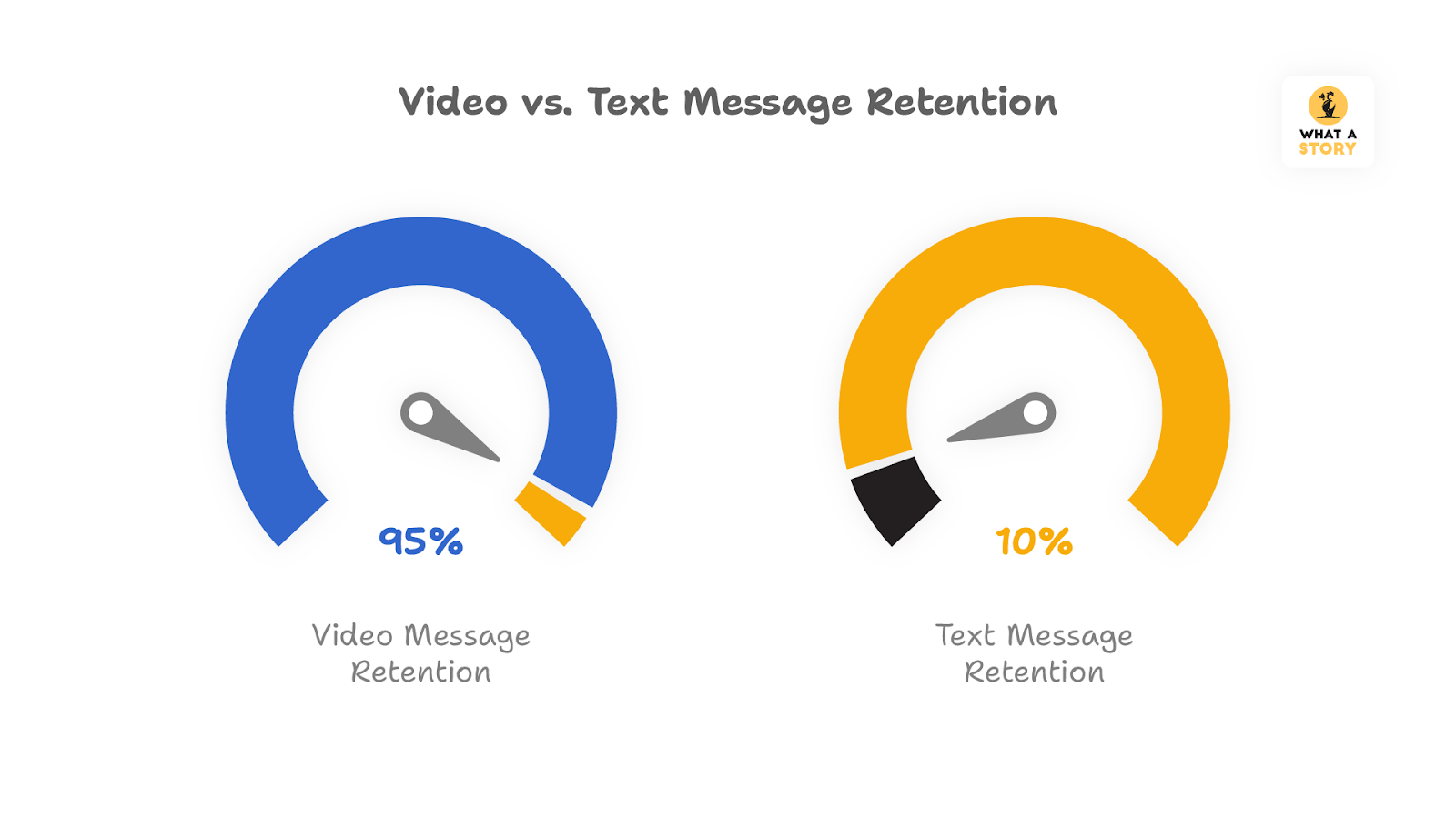
Software products are built around workflows rather than physical experiences that makes them difficult to explain through text alone.
Instead of describing how a product works, video allows prospects to see it in action.
An effective SaaS marketing video should:
- Demonstrate workflows instead of listing features.
- Show outcomes instead of technical specifications.
- Explain integrations within real business scenarios.
- Help buyers visualize how the software fits into their daily work.
When customers understand the product earlier, they reach value faster that directly improves trial activation, product adoption, and purchase confidence.
3. It supports PLG and sales led models
You can tailor your video narrative depending on the strategy that you are leading with.
If you follow a Product Led Growth model, you can shape your video narrative in multiple ways such as:
- A product demo that increases trial activation.
- An onboarding video that reduces drop- offs.
- A feature- driven video that appeals to users and drives expansion.
Whether you follow a product- led growth model, a sales-led approach, or a hybrid of both, video supports the core motion.
And if you follow a Sales Led model, you can tweak it into:
- Explainers that qualify inbound leads
- Demo videos that accelerate sales cycles
- Customer stories that drive validation and build deal confidence
In both models, video helps buyers make informed decisions with less dependence on live conversations.
For product-led SaaS businesses, a traditional explainer video isn't enough. A well-planned PLG explainer helps users understand your product and reach value faster.
4. It builds credibility and trust in crowded SaaS markets
Every SaaS category has become increasingly competitive. Buyers compare products across review websites, analyst reports, social media, customer communities, and independent recommendations before scheduling a demo.
Your website is often only one part of that research.
- Professional videos help establish credibility long before a prospect enters your sales pipeline.
- Customer success stories demonstrate measurable outcomes.
- Product demonstrations reduce uncertainty.
- Founder videos communicate vision.
- Educational content positions your company as an expert rather than just another software vendor.
Together, these assets build trust throughout the buying process and help buyers feel more confident about choosing your product.
5. It improves customer onboarding and retention
Winning a customer is only the beginning. Recurring revenue depends on customers continuing to use the product successfully.
This is where many SaaS companies underestimate the value of video. Instead of directing new users to long documentation pages, onboarding videos demonstrate the exact actions customers need to take during their first days with the product.
- Feature walkthroughs encourage deeper product adoption.
- Release videos introduce new capabilities.
- Knowledge-base tutorials reduce support requests.
- Customer education webinars help teams get more value from the software.
Every one of these videos contributes to a better customer experience.
For subscription businesses, even small improvements in retention can significantly increase long-term revenue, making onboarding and customer education some of the highest-return investments in a SaaS video marketing strategy.
The Uniqueness of B2B SaaS Video Marketing
The average B2B buying group for SaaS generally involves 6 to 10 stakeholders, operational heads, and CXOs, each with their own set of priorities and risk thresholds.
Gartner reporters have documented it time and again that less than 20 percent of SaaS buyers spend their time meeting their potential vendor; the majority will make the purchase decision based on self-guided research and peer validation.
The beauty of SaaS products is that they are not transactional in nature, they do have a real impact on workflows, data and teams…but this means that for truly scaling your SaaS through video marketing you have to work really hard on education, alignment and building trust at scale.
This will involve focusing on the following concepts:
Explaining complex workflows, not just features
One of the biggest mistakes SaaS companies make is treating features as the story.
Features matter, but buyers don't purchase software because it has more buttons or dashboards. They purchase software because it improves the way their teams work.
Your videos should answer questions such as:
- What problem does this solve?
- How does this fit into existing workflows?
- What changes after implementation?
- What measurable business outcome can customers expect?
Instead of presenting a feature list, show the transformation from the customer's current workflow to a better future state.
Multiple stakeholders in buying decisions
Imagine your product rising through a pyramid of buyers within the organisation, first come the users at the base who evaluate functionality, then come the managers who look for efficiency, then come the technical evaluators who will point out the red flags, and finally come the core decision makers who will measure the impact in the long term and make the decision on onboarding.
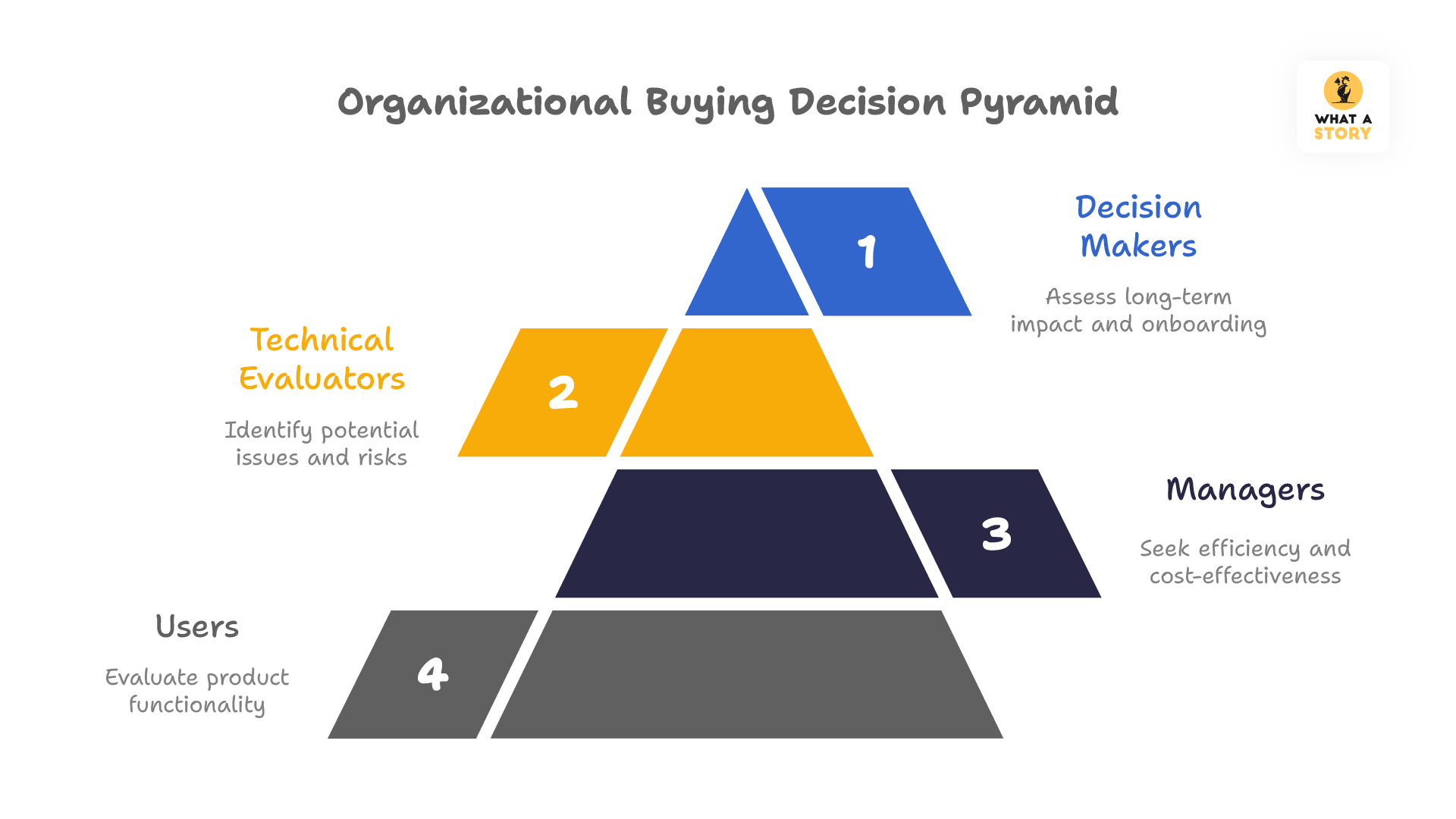
Now to truly scale with your video marketing efforts you need to tailor your messaging for each of these sets of buyers and you need:
- High-level explainer for executives and managers.
- Workflow demos for users.
- Security or integration videos for technical teams
Support the entire customer lifecycle
The role of video doesn't end after a customer signs the contract. Successful SaaS companies continue using video to educate customers long after implementation.
For example: Welcome videos improve onboarding | Feature walkthroughs increase adoption | Product update videos introduce new releases | Knowledge-base tutorials reduce support requests | Customer webinars encourage product expansion | Training videos improve long-term engagement.
When customers reach value faster, retention naturally improves.
How to Build a SaaS Video Marketing Strategy
An effective SaaS video marketing strategy isn't built around random content ideas.
It starts with business goals. Every video should solve a specific problem that currently limits growth.
Step 1: Define the business objective
Ask one simple question:
What is slowing growth today?
Examples include:
- Low brand awareness
- Poor trial activation
- Long sales cycles
- Low product adoption
- High customer churn
- Weak feature usage
Once the problem is clear, selecting the right video becomes much easier.
Step 2: Understand your audience
Before scripting any video there are three core questions you must have complete clarity on:
i) Who is making the buying decision versus who uses the product every day, since they will be caring about different outcomes you have to know who you are writing for.
ii) Narrow down the most important pain-point that often becomes your hook. A great hook ensures users don’t drop off from the early stages of the video.
iii) Third, define what success looks like in the first 30 days, because early wins drive activation, retention, and confidence in the product.
A clarity on these points will help you create videos that are sharper, your internal feedback will be more precise and your users will get exactly what they are looking for.
Step 3: Match videos to the customer journey
Different stages require different video formats.
Instead of asking,
"What video should we create next?" Ask, "What information does the customer need at this stage?"
Step 4: Build a distribution plan
Creating a great video is only the first step. To maximize its impact, plan where each video will be distributed before publishing it. Different channels serve different purposes throughout the buyer journey, so your videos should appear where your audience is most likely to engage with them.
Common distribution channels include:
- Website: Homepage, product pages, and landing pages
- Social Media: LinkedIn, YouTube, and other relevant platforms
- Email Marketing: Lead nurturing and product launch campaigns
- Sales Enablement: Personalized outreach and follow-up emails
- Customer Success: Onboarding, help center, and knowledge base
- Paid Campaigns: Search, social, and display advertising
Rather than creating separate videos for every channel, repurpose the same video across multiple touchpoints to increase its reach and ROI.
Step 5: Measure business outcomes
Views and likes can indicate reach, but they don't always reflect business impact. A successful SaaS video marketing strategy should be measured against metrics that contribute to revenue and customer growth.
Track KPIs such as:
- Demo requests to measure buying intent
- Free trial activations to evaluate acquisition performance
- Sales cycle length to understand how videos influence decision-making
- Customer Acquisition Cost (CAC) to measure marketing efficiency
- Product adoption and feature usage to assess customer engagement
- Customer retention and expansion revenue to evaluate long-term business impact
Monitoring these metrics regularly helps you identify which videos generate the most value and where your strategy can be refined for better results.
How to Write a Script for a SaaS Marketing Video
A great SaaS marketing video begins with a well-structured script. High-quality animation, motion graphics, or voiceovers can improve the viewing experience, but they cannot fix a message that lacks clarity or direction.
The most effective scripts guide viewers through a logical journey, helping them understand the problem, see the solution in action, and feel confident about taking the next step.
Here's a simple framework that works for most SaaS marketing videos.
1. Start With the customer's problem
The opening few seconds determine whether viewers continue watching. Instead of introducing your company immediately, begin with a challenge your target audience already faces. When people recognize their own frustrations, they become more interested in hearing how your product can help.
For example, instead of saying, "Welcome to our platform," start with a problem like, "Managing projects across multiple tools wastes hours every week."
2. Introduce the solution naturally
Once you've established the problem, transition smoothly into the solution. Rather than making your product the hero from the start, explain a better way of solving the challenge and then introduce your software as the tool that makes it possible. This keeps the message educational instead of overly promotional.
3. Show the product in action
One of the biggest advantages of video is the ability to demonstrate real workflows. Instead of describing features, show how they work in practical situations.
For example, rather than saying, "Our platform automates reporting," demonstrate how reports are generated in just a few clicks and how that saves time for the user. Visual demonstrations make complex software much easier to understand than lengthy explanations.
4. Focus on business outcomes
While features are important, buyers ultimately want to know how the product will improve their work. Shift the conversation from what the software does to the results it delivers.
Highlight outcomes such as:
- Saving time through automation
- Reducing repetitive manual work
- Improving team collaboration
- Increasing productivity
- Supporting better business decisions
This helps prospects connect product capabilities with measurable business value.
5. Build trust with proof
Before asking viewers to take action, reinforce your message with evidence. Social proof helps reduce uncertainty and strengthens credibility, especially in B2B SaaS buying decisions.
Depending on your product, this could include customer testimonials, case studies, product usage statistics, security certifications, industry recognition, or measurable customer success stories. Even one strong proof point can make your message far more convincing.
6. Finish with one clear call-to-action
Every SaaS marketing video should guide viewers toward a single next step. Avoid presenting multiple options, as too many choices can reduce conversions.
Instead, end with one clear and relevant action, such as:
- Book a personalized demo
- Start a free trial
- Watch a product walkthrough
- Speak with a product expert
A focused call-to-action gives viewers a clear direction and increases the likelihood that they'll continue their journey with your product.
What Videos Does Every SaaS Company Need?
As SaaS companies grow, they need more than a single explainer video. Different stages of the customer journey require different types of content.
If you prefer video over text, then watch this video
Best Distribution Channels for B2B SaaS Video Marketing
Creating a great video is only half the job. Its impact depends on whether it reaches the right audience at the right stage of the customer journey.
Unlike B2C brands that often rely heavily on social media, B2B SaaS companies need a multi-channel distribution strategy. Prospects discover, evaluate, and purchase software across websites, search engines, LinkedIn, email, communities, webinars, and sales conversations.
Each channel serves a different purpose, and your videos should be tailored accordingly.
To get the most from your investment, learn where to place your explainer videos across your website, marketing campaigns, and sales funnel.
Common SaaS Video Marketing Mistakes
Just putting together a video budget is not enough, you have to draft an effective video strategy along with it that delivers on your goals.
A good video production agency will hold your hand and create the right strategy for you, but most times marketers work with vendors who have little understanding of SaaS business and this leads to fundamental strategy gaps that almost make you lose your belief in video marketing.
But it is not videos that are the problem here but some common mistakes that so many marketers make.
Inconsistent messaging, an excessive feature driven approach to the script, a lack of clear call to action and video that is too indulgent in its own products.
There are many reasons like these that can lead to your product demos, explainer and onboarding videos to underperform and underdeliver frustratingly.
We have analysed hundreds of videos and have written about these mistakes in detail here and here.
Once you have taken a note of these mistakes you are now ready to craft high impact video strategy.
Measuring the Success of Your SaaS Video Marketing Strategy
The success of a SaaS video marketing strategy shouldn't be measured by views alone. The most valuable videos are those that contribute to business growth.
Consider tracking metrics such as:
Review these metrics regularly to understand which videos influence revenue and where additional content is needed.
If you want a deeper understanding of how to calculate returns, read our detailed guide on explainer video ROI and the metrics that matter most for SaaS businesses.
Optimizing SaaS Videos for AI Search and SEO
Search behavior continues to evolve. Buyers increasingly discover products through Google AI Overviews, ChatGPT, Gemini, Perplexity, and other AI-powered search experiences. Optimizing your videos for both traditional search engines and AI platforms improves their visibility and long-term value.
Some best practices include:
- Publish videos on dedicated landing pages with descriptive copy.
- Include complete transcripts to improve accessibility and search relevance.
- Add VideoObject Schema to help search engines understand your content.
- Write clear titles and descriptions that reflect user intent.
- Organize videos with headings and supporting text rather than relying solely on embedded media.
- Internally link related product pages, blogs, and case studies to create stronger topical relationships.
These steps make it easier for both search engines and AI systems to understand, reference, and recommend your content.
Frequently Asked Questions
What is B2B SaaS video marketing?
B2B SaaS video marketing is the use of video content to attract prospects, educate buyers, support sales teams, onboard customers, and improve product adoption throughout the software customer lifecycle.
Why do SaaS companies invest in video?
SaaS companies use video to simplify complex products, reduce sales friction, improve customer education, increase product adoption, and strengthen customer retention.
How do enterprise SaaS companies use video?
Enterprise SaaS organizations create videos for product demonstrations, sales enablement, executive presentations, security overviews, onboarding, training, and customer success initiatives.
What videos should every SaaS company create?
A complete SaaS video library typically includes brand videos, explainer videos, product demos, customer testimonials, onboarding videos, tutorials, feature updates, webinars, and customer success stories.
How do you measure SaaS video marketing ROI?
Rather than focusing only on views, measure outcomes such as demo requests, trial sign-ups, trial-to-paid conversion rates, customer acquisition cost, product adoption, customer retention, and expansion revenue.
In Conclusion
At What a Story we have created 1200+ videos for SaaS and tech companies from around the world and we see that one pattern is consistent - the teams that see real impact from video are not chasing trends or formats, they are building a highly effective video strategy into their growth systems.
We have seen firsthand that video works best when it is treated as infrastructure, not a one off campaign.
Explainers that sharpen positioning, demos that reduce sales friction, onboarding videos that accelerate time to value, and customer stories that reinforce trust all serve different but connected purposes.
When these pieces come together, video stops being a cost center and starts becoming a compounding growth asset.


