
Most SaaS companies don't need more content. They need the right content.
Over the years, we've seen SaaS teams spend thousands of dollars creating random videos, only to realize later that they ignored the videos that actually help move prospects through the funnel.
The truth is simple:
Not every video contributes equally to growth.
Some videos create awareness. Some build trust. Some help close deals. Others improve activation and retention.
If I were building a SaaS company from scratch today, these are the 7 videos I would invest in first.
1. Product Launch Video
A product launch video is exactly what it sounds like: a short, exciting introduction to your product or feature before it officially launches.
You can call it a launch video, teaser video, announcement video, promo video, or product introduction video.
The objective is always the same: Create anticipation.
People love discovering something new. They love feeling like they are getting an early look at something important. That is why launch videos work so well.
Think about how Apple introduces new products. Months of speculation, followed by carefully crafted teaser content and launch videos that create excitement long before the product reaches customers.
No, your SaaS company is not Apple. But the psychology is the same.
A well-produced launch video can help:
- Generate awareness before launch
- Increase event attendance
- Support webinar promotions
- Improve feature adoption
- Drive traffic from email campaigns and social media
Keep them short. Leave some mystery. The goal is not to explain everything. The goal is to make people want to learn more.
Related Reading: SaaS Product Launch Video Strategy
2. Product Demo Video (Overview Video)
Once people understand that your product exists, they want to know how it works. That is where product demo videos come in.
A product demo video shows your software in action. Unlike an explainer video, which focuses on the problem and solution, a demo video focuses on the actual experience of using the product.
Prospects want answers to questions like:
- What does the dashboard look like?
- How easy is it to use?
- How long does setup take?
- Does it fit my workflow?
A great demo video answers these questions before a sales call even begins.
One mistake we often see SaaS companies make is confusing demo videos with explainer videos.
They are not the same thing. Explainer videos introduce the product and demo videos validate the product. Both are important.
The strongest SaaS websites often use both.
If you want a deeper breakdown, check out our Product Demo Video Guide.
3. Product Explainer Video
If I could recommend only one video for a SaaS company, it would be an explainer video.
Why?
Because nobody books a demo for a product they don't understand. Your explainer video is often the first salesperson your prospect meets.
It works 24/7. It appears on your homepage. It gets shared by your sales team. It gets embedded in presentations.
And if done well, it can become one of the highest-performing assets on your website.
A strong explainer video should answer four questions:
- What problem exists?
- Why does it matter?
- How does your product solve it?
- Why should someone care?
Most SaaS explainer videos work best between 60 and 90 seconds. Long enough to communicate value and short enough to hold attention.
Animation works particularly well because many SaaS products deal with workflows, automation, analytics, APIs, and processes that are difficult to show through live-action footage.
The goal isn't to impress viewers with animation. The goal is clarity.
Always choose clarity over creativity.
Related Reading:
4. Product Tutorials
Product tutorials are probably the most common SaaS video format. They are also some of the most overlooked.
Many SaaS companies spend heavily on acquisition and then leave new customers to figure everything out themselves. That is a mistake.
The first few days of the customer journey are often the most important. If users feel lost, they leave. If users achieve an early win, they stay.
That is why tutorial videos matter.
You may know them as:
- Walkthrough videos
- Training videos
- Onboarding videos
- Help center videos
- FAQ videos
- How-to videos
Most tutorials rely on screen recordings combined with narration, annotations, motion graphics, or visual callouts.
The key difference between tutorials and explainers is simple:
Explainer videos introduce features. Tutorial videos teach people how to use those features.
A good tutorial reduces support tickets. A great tutorial improves retention.
Related Reading: Common SaaS Onboarding Mistakes
5. Testimonial Videos (Case Studies)
Nobody trusts text testimonials anymore. At least not enough to buy software because of them.
Think about your own buying behavior. How many software purchases have you made after reading a few generic testimonials on a landing page?
Now compare that to hearing a real customer explain:
- What problem they had
- Why they chose a solution
- What results they achieved
That feels different. That feels believable. Customer testimonial videos remain one of the strongest forms of social proof available to SaaS companies.
They help prospects answer a crucial question:
Will this work for someone like me?
The best testimonial videos focus on outcomes, not praise. Instead of: This product is amazing.
Aim for: We reduced onboarding time by 42% after implementing this solution. Specific results create credibility.
We have written a complete guide on Testimonial Videos.
6. Commercial Video / Ad films
Once you have reach a stage when your MRR is more than your CAC, have a commercial ad made for your product.
You will thank me later.
Ad films (Live shoot) is the kind of video that can elevate your WOM marketing through the roofs. Everybody will know about your product.
They generally get planned for 60 seconds, then edited into short form for campaign adoption like 45 sec, 30 sec, 15 sec, and 6-sec bumper ads.
There are some situations when you don't need an ad-film (and should avoid getting it), reach out to me and I will help you decide whether to go for this video or not.
7. Corporate Videos
You can also call these videos Company Culture, Meet the Team, Company Profile, Behind the Product, Brand Story, or simply Corporate videos.
These types of videos give your audience a behind-the-scenes look at your company's origins, mission, values, and culture. They're a powerful way to build trust and loyalty with your customers, and differentiate your business from competitors.
These videos usually include interviews with key team members, footage of your office or workspace, and images or footage of your products or services. They help bring your story to life and showcase your brand's personality.
Overall, company story videos can help you create a strong emotional connection with your customers, lead to increased loyalty, and ultimately drive more sales.
So, why not give them a try and see how they can help you build a deeper connection with your audience?
Other Videos That Can Have a Massive Impact
Once your core video assets are in place, there are several supporting formats worth considering.
Thank You Videos: - Imagine signing up for a product and seeing a welcome message from the founder. Not an automated email. An actual video.
Done well, it creates a memorable first impression.
Educational Videos: - Turn your best-performing blog posts into videos. Many SaaS companies underestimate how much traffic and visibility they can gain through educational content on YouTube and search.
Product Feature Update Videos: - Every feature release is an opportunity to reconnect with customers. A short update video often communicates value much faster than a release note.
Podcast and Webinar Videos: - If you're already investing in webinars or podcasts, repurpose them into smaller video clips for LinkedIn, YouTube, and social media.
Milestone Videos: - Celebrate launches, funding rounds, customer milestones, team growth, and company achievements. These moments help humanize your brand and strengthen relationships with your audience.
Which SaaS Video Should You Create First?
If you're starting from scratch, I would recommend creating videos in this order:
This sequence follows the natural SaaS customer journey.
Awareness comes first. Trust comes second. Retention comes third.
How What a Story Helps SaaS Companies Create High-Impact Videos
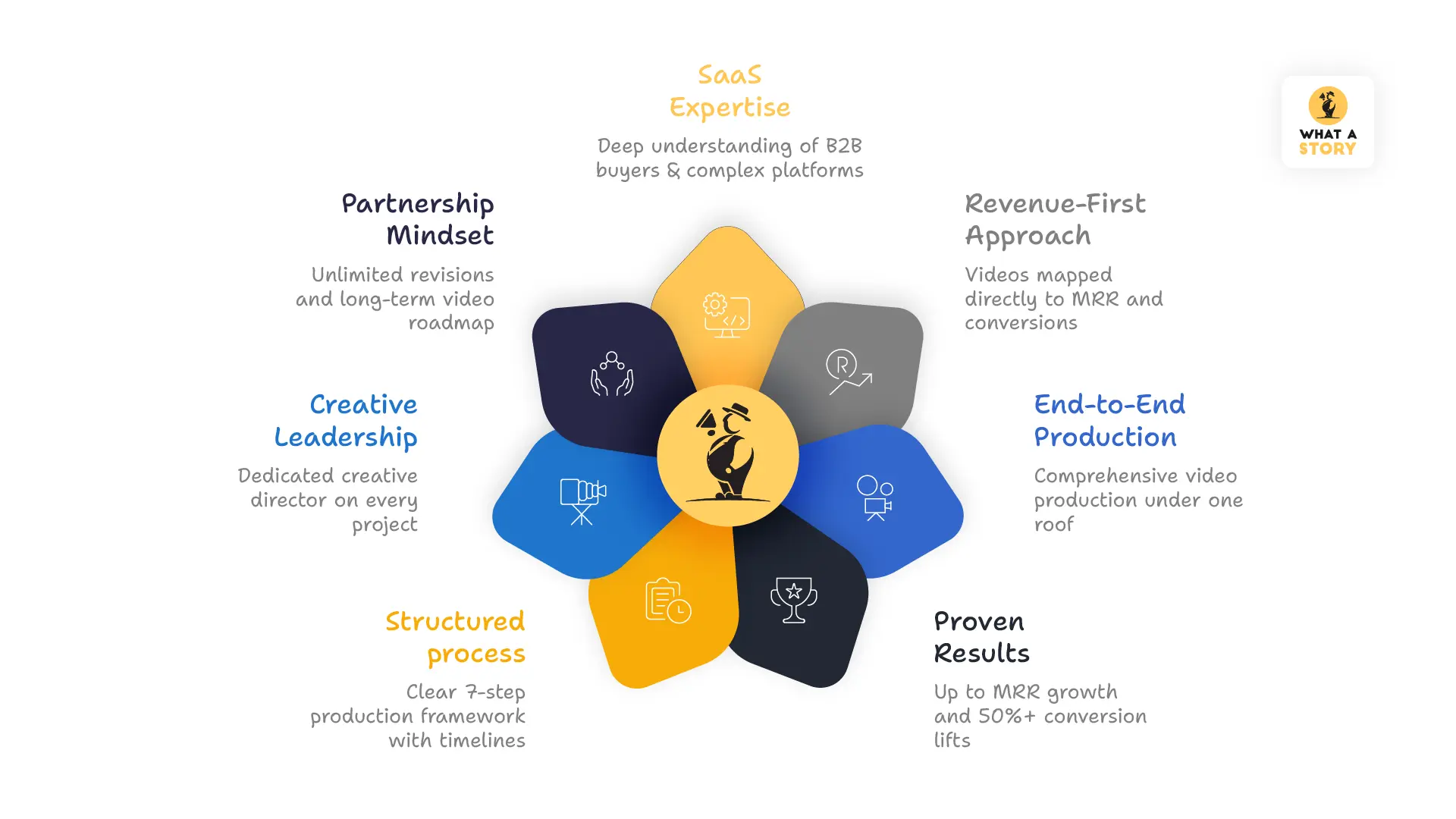
What a Story is a SaaS-focused video agency that helps subscription businesses grow MRR, adoption, and retention through strategic video content.
We specialize in turning complex products into clear, conversion-driven stories, producing everything from explainers and demos to onboarding and customer proof - fully in-house and built for long-term impact.
Conclusion
These are the seven videos I would order for my SaaS to be successful.
What other videos can you employ? Let me know.
You can also call my team or message us at we@whatastory.agency to get a 100% free consultation on any kind of video.
We don't sell. We sail.
FAQs
How long should a SaaS explainer video be?
Most SaaS explainer videos work best between 60 and 90 seconds. This window gives enough time to name the problem, introduce the product, show a simple view of how it works, and make a clear call to action without losing attention.
What's the difference between an explainer Video and a product demo?
An explainer video explains what the product is and why it matters, while a demo shows how it works. Explainers target early-stage users and give a quick overview, usually in 60–90 seconds.
Demos speak to consideration-stage users and walk through real workflows in more detail. Both support different stages of the same SaaS funnel.
How much does it cost to produce a professional SaaS video?
Video costs vary by format, length, and complexity. Screen-recorded demos are usually cheaper, while high-end animated explainers and live-action testimonials cost more due to design, production, and logistics.
Script, animation detail, revisions, and voice talent also impact pricing. The right budget depends on how directly the video supports revenue.
How do I measure the ROI of my SaaS videos?
Measure each video by its role. Explainers focus on views, engagement, clicks, and conversion lift. Demos are judged by watch time, demo requests, and sales cycle impact.
Onboarding videos tie to activation, usage, and fewer support tickets. Use tracking links, clear CTAs, and feedback from sales and users to connect video views to real outcomes.
Should I use animation or live-action for ny SaaS video?
The right format depends on the goal. Animation works best for abstract or complex ideas and stays relevant as products change. Live action fits testimonials and human stories, while screen recordings are ideal for showing the real product.
Many SaaS videos combine these formats, and the best mix depends on the audience, goal, and budget.
How often should we create new video content?
There’s no perfect schedule, but consistency matters more than volume. Refresh core videos once or twice a year, create new educational or feature videos monthly, and share short clips weekly. Start with essential SaaS videos, then scale based on results. Repurposing and a simple content calendar help keep output steady.