
We created a “visually average” video that made $20,000 in 3 days.
And around the same time, we watched a beautifully animated video fail completely.
There’s a video I think about often. We produced it three years ago for a fintech startup. The budget was modest. The animation was clean but not exceptional.
It had 2D characters, simple backgrounds, and a motion style we’d used variations of dozens of times before. No elaborate transitions. No cinematic colour grading. Nothing that would make another animator stop and study the craft.
It generated $20,000 in revenue within three days of going live.
Around the same time, a competitor released a video for a similar company in the same category.
The animation was genuinely beautiful. Fluid character movement. Intricate scene compositions. The kind of visual work that wins awards at motion design festivals.
The studio had clearly spent real money and real talent on every frame.
It did nothing. The company quietly removed it from their homepage four months later.
"Of course, a script needs an audience to work - but even with identical ad spend, the beautiful video lacked the narrative hook to stop the scroll."
The Most Important Truth About Video Marketing
I’ve thought about that contrast more than almost anything else in ten years of production work. Because it contains a simple truth the industry consistently gets backwards:
The quality of the story determines the performance of the video. The quality of the animation determines whether people notice the craft.
Those are not the same thing. And confusing them is one of the most expensive mistakes a SaaS or B2B company can make.
Why The Industry Talks About Animation First
The answer is straightforward: Animation is visible. Storytelling isn’t.
When a founder watches a video, they can see the animation. They can judge whether it looks premium, smooth, or polished.
That creates an immediate reaction: This looks good. or This looks cheap. That reaction feels like useful information.
But what they can’t see is:
- The structural decision to open with the viewer’s frustration instead of the product name
- The script rewrite that replaced a feature list with a single emotional truth
- The thinking that shaped the viewer’s journey before a single frame was designed
Storytelling is invisible when it's working. Which means it doesn't get the credit.
Animation is always visible. Which means it gets all of it.
The result is a market where companies brief video agencies with reference videos.
"We want something that looks like this", rather than reference outcomes. They're optimising for the thing they can see rather than the thing that converts.
What Animation Quality Actually Does (And Doesn’t Do)
Let me be precise about this, because I'm not making an argument against beautiful animation. I'm making an argument about what it does and doesn't do.
Animation quality affects three things:
first impression,
perceived credibility,
and brand fit.
In fact, over-engineered visuals can create high cognitive load. When the animation is too busy, the brain spends its energy decoding the art instead of hearing your message.
“Simple visuals often win because they stay out of the way.”
A video with high production values signals investment and investment signals confidence.
A company that has clearly spent money on a well-crafted video is communicating, implicitly, that they believe in what they're selling. That's a real signal and buyers pick it up.
A premium enterprise software company that releases a video with stock character animation is sending a confusing message: the positioning says enterprise, the production values say startup. That misalignment creates a subtle credibility gap.
So animation matters. It absolutely matters.
But here’s what animation cannot do:
- It cannot make a viewer care about a story that isn’t there
- It cannot create recognition (“this is about me”)
- It cannot generate the emotional shift that drives action
Beautiful animation on a weak story is an expensive way to impress creatives and convert nobody else.
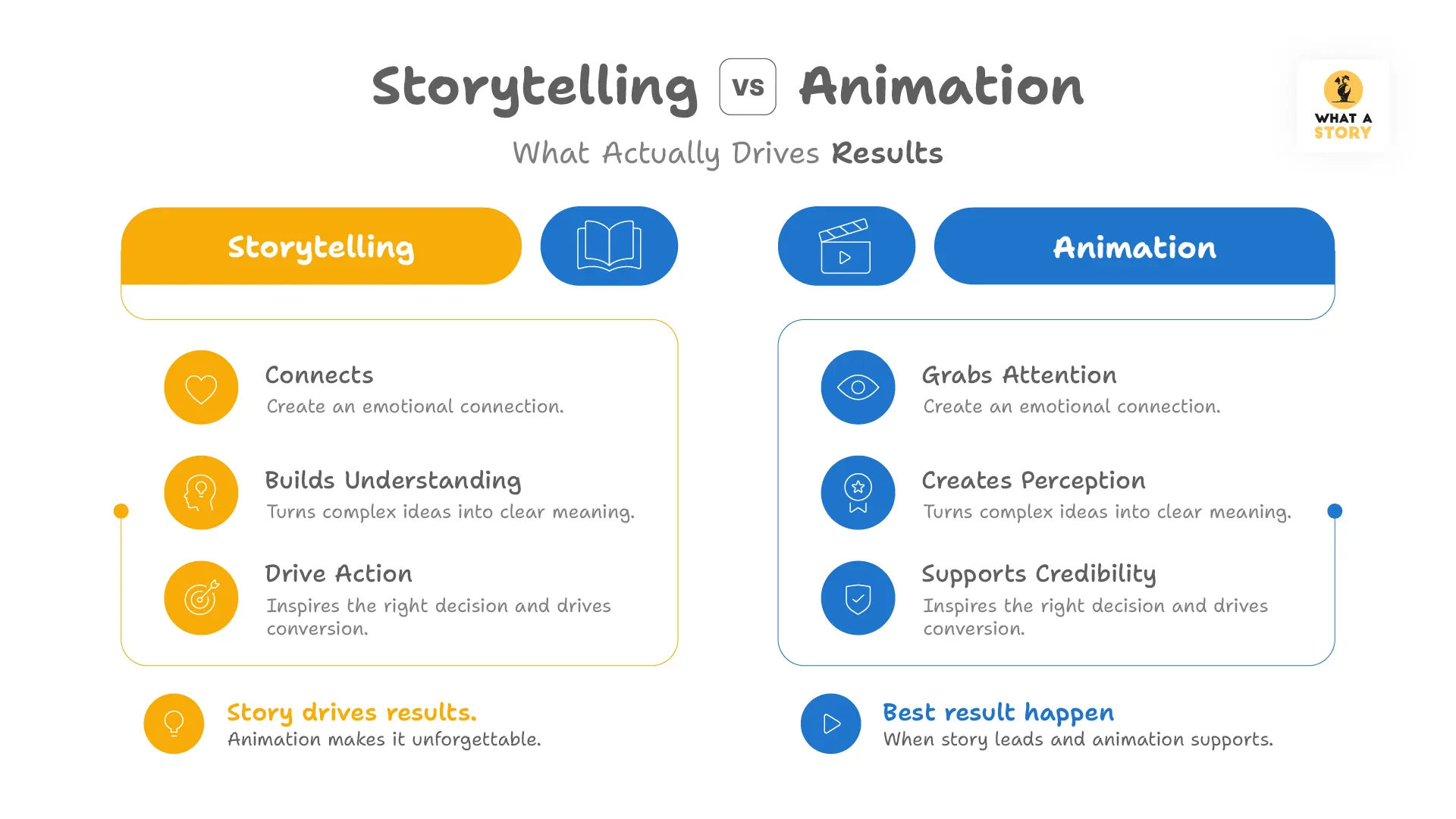
Storytelling vs Animation: What Actually Drives Results
The industry has a habit of over-complicating this, but the math is simple. Animation is a multiplier, not a foundation.
If your story has a value of zero, it doesn’t matter how much you multiply it by high-end motion design, the result is still zero.
We focus on results as a business objective (revenue, sign-ups, trust), not as a craft objective. When you look at the actual mechanics of why a viewer decides to click a CTA, you realize that the heavy lifting happens long before the first frame is animated.
The Hierarchy of What Makes a Video Work
After 1,200+ videos across SaaS, Fintech, HealthTech, and B2B Tech, here is the hierarchy as I've come to understand it.
This is in order of impact on whether the video achieves its business objective:
0. Distribution Strategy – If the video isn't placed where the buyer already is, the rest of this list is academic.
1. The brief - who is the viewer, what do they need to feel, what are they being asked to do.
2. The script - does it open on something the viewer recognises, does it earn the right to introduce the product, does it close on a clear and low-friction ask.
Note: A B2B story isn't a plot; it’s a transformation. It’s the bridge between the viewer's current pain and their future relief.
3. The structure - is the emotional journey from recognition to possibility to agency clear and uninterrupted.
4. The voiceover - does the voice create the right relationship with the viewer, does the pacing give ideas room to land.
5. The visual direction -does the style match the emotional tone of the story, does it serve the narrative or compete with it.
6. The animation quality- is the craft execution consistent and credible.
Animation quality is sixth. Because everything above it must work first.
A perfect animation with a weak script → looks impressive, converts nobody. A strong story with modest animation → performs
That’s the difference.
What the B2B marketing community says
This isn’t just our internal philosophy. When I shared this perspective in the B2B Marketing community, the consensus was clear: "Great animation can grab attention, but weak messaging kills performance fast."
As one marketer put it: "If the story isn't strong, better visuals just make the mistake more expensive." You can read the full community discussion on whether storytelling matters more than animation quality here.
The Script Is the Product
Everything that comes after, the storyboard, design, animation, voiceover, sound design is the process of revealing what the script already decided.
If the script opens on the wrong thing, no amount of beautiful animation will fix it. If the script tries to communicate fourteen points in ninety seconds, the most fluid motion design in the world won't give the viewer enough time to absorb any of them.
If the script's CTA is vague or passive, the viewer will watch to the end and then close the tab, regardless of how satisfying the final scene looks.
The script is where the performance of the video is determined. Production is where the experience of the video is determined.
But 'the script' isn't a monolith. To see which approach fits your product, explore our guide on the 5 different explainer video scriptwriting styles.
A Real Example: When Story Changed the Outcome
We worked with a HealthTech company that came in with a clear visual reference. They knew how they wanted the video to look.
But they didn’t know:
- Who exactly was watching
- What that person feared
- What they needed to believe before acting
So we didn’t touch visuals for two weeks. We worked on the brief. We mapped the viewer: A hospital procurement lead under time and budget pressure.
The real fear wasn’t: “Will this technology work?” It was: “Will I be blamed if it doesn’t?”
That’s a different story. And it required a different tone.
When we reached visual direction, we chose something quieter. More credible. Less dynamic. Because the story demanded it.
When Animation Quality Does Matter And When It's a Distraction
There are contexts where animation quality is a genuine strategic variable, not just a craft consideration.
When your buyer is comparing you directly to enterprise competitors and production values are a proxy for company maturity. This is when animation quality signals that you belong in the same conversation.
A Series B company competing for enterprise contracts cannot afford to look like a pre-seed startup. The visual polish is part of the positioning.
When the product is inherently visual- hardware, physical infrastructure, complex 3D environments, the animation needs to accurately represent something the viewer can't otherwise imagine. Here, the craft of the visualisation is doing real strategic work.
When the creative style is itself part of the brand differentiation: a company that has built its entire market identity around a distinctive visual language is making a different calculation than a company that just needs to explain what it does.
Outside of those contexts, animation quality is a hygiene factor, not a competitive advantage. It needs to be good enough that it doesn't undermine the story.
Beyond that threshold, additional investment in animation quality produces diminishing returns on conversion.
What never produces diminishing returns at any budget level, for any company, in any category is investment in the story itself.
To be clear: there is a 'floor.' If the audio is tinny or the frames are jarring, you lose the viewer before the script even starts. Animation must meet the 'Professional Baseline' just to earn the right to speak.
The 70/30 Rule of High-Performing Video
If you want ROI, spend 70% of your energy (and a significant portion of your budget) on the strategy, the brief, and the script. Use the remaining 30% to make it look credible. Most companies do the exact opposite, which is why most videos fail to pay for themselves.
The Brief That Reveals Everything
There's a question I've started asking in early client conversations that tells me almost immediately where the priorities are:
"If this video could make the viewer feel one specific thing what would that be?"
The clients who answer that question quickly and specifically, "like the problem they've been managing for three years is finally solvable" or "like our team genuinely understands what their week looks like" are the clients whose videos perform.
Because they've already done the hardest thinking. They know what they're trying to create in the viewer's experience, and that knowledge drives every subsequent decision correctly.
The clients who answer with something about visual style premium or dynamic or clean and modern are the ones who need the most help before we touch a script.
Because they're thinking about the output rather than the outcome.
And the gap between those two things is where most video budgets disappear without producing the results they were supposed to.
What This Means If You're Commissioning a Video
Ask your agency one question before you discuss visual style, duration, or production budget:
"What does this video need to make my viewer feel and how does your script create that feeling?"
If the answer is specific, if they can tell you exactly what emotional state they're designing for and precisely how the opening eight seconds get the viewer there, you're working with people who understand what makes video work.
If the answer defaults to discussion of animation style, reference videos, or production quality before the story question is answered, that's useful information but it won’t get you what you need.
Final Takeaway
Storytelling drives performance. Animation enhances perception.
They are not equal. And they do not work in reverse order. If the story fails, no level of animation can save the video.
If you're planning a video, start with the story, not the style. Because once the script works, everything else becomes easier.
And if it doesn't, nothing else will fix it.


