


Many SaaS video briefs begin with a simple requirement: We need one video that explains our product.
But that’s not how it works.
A SaaS company can sell the same product in ten countries and still have ten different conversations with its customers.
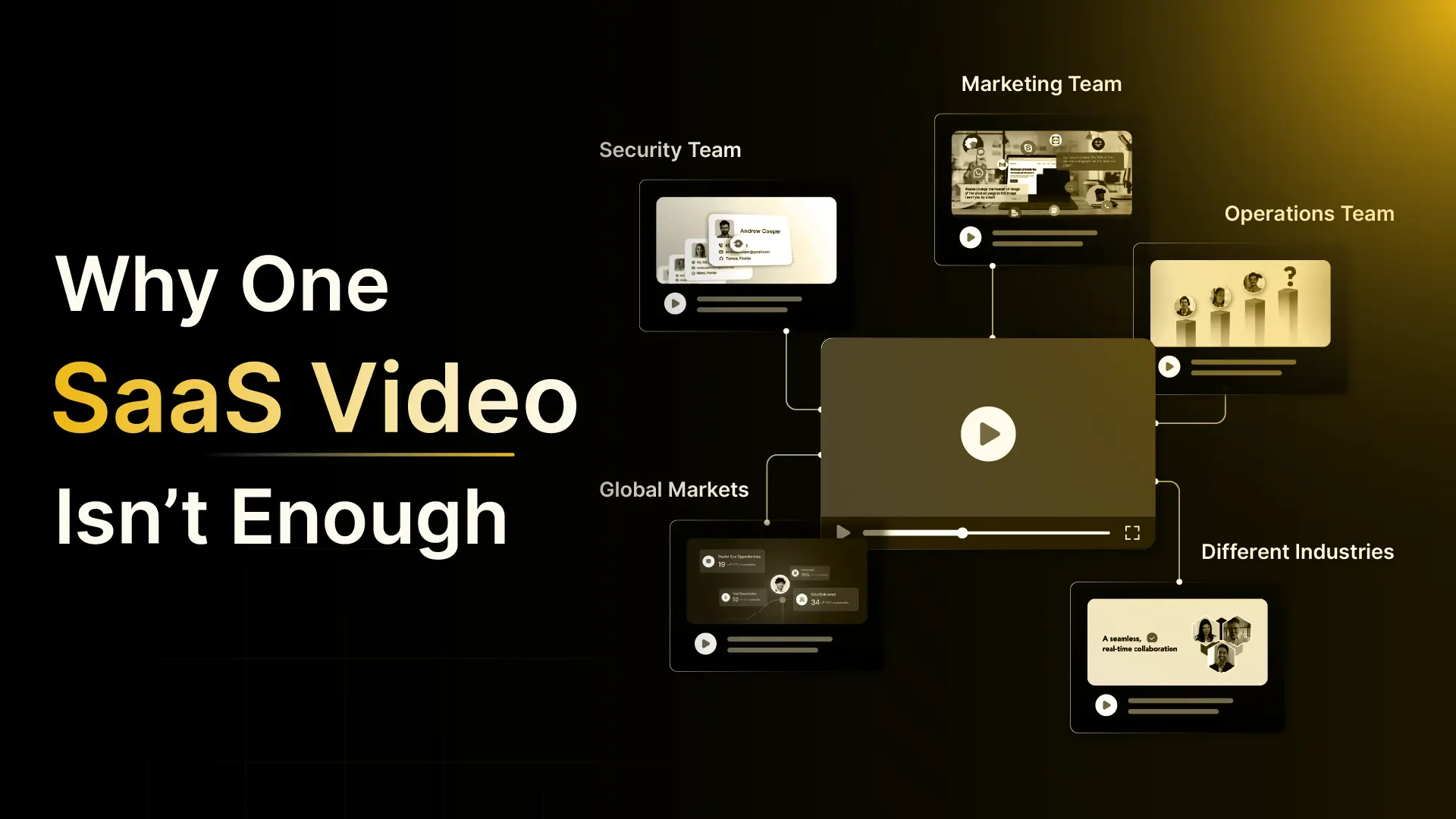
A security leader may want to understand integrations and compliance. A marketing team may care about acquisition and reporting. An operations leader may want to know how the software fits into an existing workflow.
The product is the same. The questions are not.
The brief then grows. Explain the problem. Introducing the company. Show the platform. Cover the key features. Explain the integrations. Add use cases. Include customer proof. Make it relevant to several industries. Then translate it for different markets.
The result: a long video with plenty of information but very little focus.
This matters because video is now a standard part of SaaS marketing. Wyzowl's 2026 research found that 91% of businesses use video as a marketing tool, while 68% of video marketers create explainer videos.
The question is no longer whether SaaS companies should use video.
It is which video a particular audience needs, what that video needs to explain, and where it fits into the buying process.
One SaaS product can have several audiences
The first mistake is often made before production begins: defining the audience too broadly.
B2B SaaS buyers isn't really an audience from a video perspective.
Several people may be involved in evaluating the same product, and each can approach it with a different question.
A CTO wants to know if the product can work with their existing technology stack. An operations manager will see how much manual work the product can remove. A marketing leader would see if it improves their acquisition process. While a finance leader may care more about implementation cost and measurable business value.
A single video cannot give equal weight to all of these concerns in 90 seconds. It has to decide which question it is answering.
That means a useful SaaS video brief should establish:
- Who is watching?
- What problem are they trying to solve?
- What do they already know?
- What information do they need next?
- What action should they take after watching?
Once those answers are clear, the production approach becomes much easier to define.
SaaS products are often simple to explain
Complex SaaS products are often difficult to explain because there is too much worth explaining. A mature platform may have dozens of features, multiple workflows, integrations and several user roles. Every internal team can make a reasonable case for including its own information.
The product team wants the features in products. Sales people want the differentiators. Marketing wants brand positioning. The viewer gets all of it. That's where the problem starts.
What a Story's analysis of more than 1,000 SaaS explainers and product videos found that 60 - 90 seconds was the most common length, accounting for 34% of the videos studied. Another 24% fell between 90 and 120 seconds.
There is nothing inherently special about 90 seconds. A product demo may need five minutes, while a paid-social video may need 30 seconds.
At 140 words per minute, a 90-second voice-over gives you roughly 210 spoken words. That's enough to make one clear argument but not enough to document an entire enterprise platform. The constraint is real.
So instead of looking to fit all your SaaS product features into one video, you can prioritize what viewers actually need to understand.
Everything else can live somewhere else.
One product can go beyond one video
Once the communication objective is clear, the need for different video formats becomes much easier to understand.
A SaaS company might need:
- An explainer video to establish the problem and introduce the product.
- A product demo to show how a workflow works.
- A feature video to explain one capability properly.
- An industry-specific video to show how the product applies to a particular use case.
- A customer story to provide evidence from a similar company.
- A product launch video to explain what's new.
These videos might simply look like different versions of the same asset but they are not. They answer different questions.
A feature-heavy demo may be useful for someone already evaluating the product but make a poor first-touch explainer. Similarly a short homepage video may introduce the product effectively but be inadequate for a sales conversation where a prospect wants to see a specific workflow.
More than figuring out which format is best, it's important that which format is appropriate for the question you’re trying to answer.
Start with the problem, then show the product
One of the most common SaaS video openings is also one of the easiest to write:
“[Company] is an AI-powered platform that helps businesses…”
It may be accurate. It may also give the viewer very little reason to care.
In What a Story’s report, problem-statement openings appeared in 34% of the videos studied, compared with 28% that began with a product introduction. These are observational findings from the dataset, not proof that one opening universally produces better conversion.
Start with the reason the viewer needs the product before asking them to understand the product.
Take an example of a workflow automation platform.
A product-first opening could list automation, integrations and reporting capabilities. A problem-first opening could establish what happens when a team is still managing a repetitive workflow across disconnected tools.
The second approach gives the product a reason to appear. The viewer understands the situation first. The product then becomes the answer. For complex SaaS products, the context can make the difference between watching a product demonstration and simply watching a sequence of screens.
Show the product, but don't make the UI do all the explaining
There is another common mistake: turning a SaaS explainer into a screen recording from beginning to end. Showing the real product matters. What a Story's analysis found that 72% of the SaaS videos studied showed the actual product interface. But an interface demonstrates what the product looks like. It doesn't necessarily explain why the workflow matters.
For example, a platform automates a complicated data process. The UI can show the dashboard and the actions a user takes. While the animation or diagrams can explain the fragmented process that existed before, how information moves between systems, and what changes after automation.
The two approaches have different jobs where animation can explain the concept, product UI can demonstrate the product.
The strongest videos often use both.
The decision should come from what the viewer needs to understand, not from a preference for animation or screen recording.
Relatable read: Screen Recording vs Custom UI Animation vs Hybrid: Which SaaS Demo Video Should You Choose?
Localization is more than translating the voice-over
When your SaaS product is meant to be solved across several markets, the video should too. So a single language won’t cut it. A global brand can have a consistent product and still face very different customer expectations from one market to another.
Localization can affect:
- Script wording
- Industry terminology
- Customer examples
- Product UI
- On-screen text
- Voice-over and captions
- Regulatory references
- Customer proof
- Calls to action
CSA Research's B2B research found a strong preference for localized experiences among business technology buyers. In its survey, 66% of business users said they would pay up to 30% more for a localized product.
That doesn't mean every SaaS company should produce a completely different video for every country. Sometimes the core story is universal. The company may only need a different voice-over, captions, UI and selected examples.
In other cases, the audience's concerns are different enough that the story itself needs to change. That's the distinction between translation and localization.
When should you localize, and when should you create a new video?
The decision can usually be made before production.
Keep the same core video when:
- The customer problem is largely universal.
- The product workflow is the same.
- The visual explanation works across markets.
- The positioning remains consistent.
Localize the existing video when:
- The language changes.
- Product UI needs translation.
- Examples need regional relevance.
- Terminology or proof points differ.
- The CTA needs market-specific treatment.
Create a separate video when:
- The use case is materially different.
- The buyer has a different primary concern.
- The workflow changes.
- Regulatory requirements alter the explanation.
- The audience needs a substantially different story.
This prevents two common mistakes: producing an entirely new video when a localized version would have been enough or forcing the same video into every market when the audience actually needs a different explanation.
Build the video around the buyer's question
A useful SaaS video strategy can be mapped around a few simple questions:
The important part is whether each video has a distinct job and not the number of videos. A first-time visitor may need to understand the problem and the product. On the other hand a returning prospect may need to see the product in action. A sales-ready buyer may need evidence that the product works for companies like theirs.
Trying to serve all three with the same video often leads to an asset that is too detailed for the first audience and not detailed enough for the last.
One core story can support multiple assets
There is also a practical advantage to building from a strong core story.
A SaaS company can develop a primary product narrative and then create relevant variations:
Core product story → industry version → feature cut → sales asset → social cut → localized version
But reuse has limits too.
If a healthcare audience has a fundamentally different problem from a general SaaS audience, changing the voice-over won't make the video specific to healthcare.
Likewise, if the workflow changes substantially between markets, replacing a few screenshots isn't enough.
Efficient production isn't about reusing the maximum amount of footage. It is about reusing the parts of the story that remain relevant.
A simple framework before production starts
Before commissioning the next SaaS video, answer five questions:
1. Who is watching?
Define the buyer, industry, market and level of product knowledge.
2. What problem are they trying to solve?
This should shape the opening.
3. What does this video need to explain?
Give the video one primary communication job.
4. What needs to change for this audience or market?
Separate simple translation from genuine localization.
5. What should the viewer do next?
The CTA should match the video's purpose and the buyer's stage.
These questions can prevent a common problem in SaaS video production: starting with the animation style, video length or feature list before deciding what the audience actually needs to understand.
The Goal is Better-defined Videos
SaaS companies rarely have a shortage of information. On the contrary, they have too much of it. Too many features, audiences, use cases, markets and internal stakeholders competing for limited attention.
That's why the most important video decisions often happen before production.
Sometimes the answer is one focused explainer.
Sometimes it is a product demo supported by feature videos.
Sometimes different industries or markets need different stories.
And sometimes the existing video is already doing its job.
The point isn't to create more videos.
It is to make sure every video has a clear reason to exist.
Don't ask how much of your SaaS product you can fit into one video. Ask what this audience needs to understand - and build the video around that answer.


