TL;DR: SaaS explainer videos fail to convert not because the animation is weak, but because the script talks to the wrong part of the brain. Feature walkthroughs engage only the analytical brain, which looks for reasons to say no. A well-structured script triggers a chemical sequence - cortisol, oxytocin, dopamine - that lowers defenses instead. This piece breaks down the neuroscience behind that sequence, why "Status Quo Bias" is the real competitor to your product, how to write for a fragmented B2B buying committee, and a four-part script blueprint we've used across 1,200+ SaaS video projects at What a Story.
Every quarter, SaaS and AI companies pour thousands of dollars into high-end motion design, 3D tracking, and pixel-perfect UI animation. Then the video sits on a landing page, collects views, and does nothing to shrink the sales cycle.
We've watched this pattern play out across 1,200+ video projects for scaling tech brands, and the reason is almost always the same: animation is a multiplier, not a foundation. If the story underneath has zero psychological pull, multiplying it by expensive graphics still gets you zero.
Most tech videos are built for the logical brain alone. They list features, show clean dashboards, and explain the API. But even skeptical enterprise buyers don't decide with logic first - they decide with the emotional, cognitive, and often subconscious triggers that make up buyer psychology, then reach for logic afterward to justify the call.
If you want your explainer, brand, or product demo video to actually convert, stop scripting around what your software does. Start engineering the narrative around how your buyer's brain processes it.
1. What Happens in a Buyer's Brain During a Product Video
When a prospect watches a dry, feature-heavy walkthrough, only the language and analytical centers of the brain - Broca's area - light up. They evaluate your claims coldly, actively hunting for reasons to dismiss the platform as too complex, too risky, or simply unnecessary.
A well-structured narrative works differently. Neuroeconomist Paul Zak's research at Claremont Graduate University has shown that a story only moves people to act once it first earns and sustains their attention through narrative tension - once that tension takes hold, viewers start mirroring the emotions of the characters on screen, and keep carrying those feelings after the video ends.
Zak lays this out in detail in his piece for Harvard Business Review, Why Your Brain Loves Good Storytelling, where he ties narrative tension directly to measurable oxytocin release.
Applied to a SaaS video, that research maps onto a three-part chemical sequence:
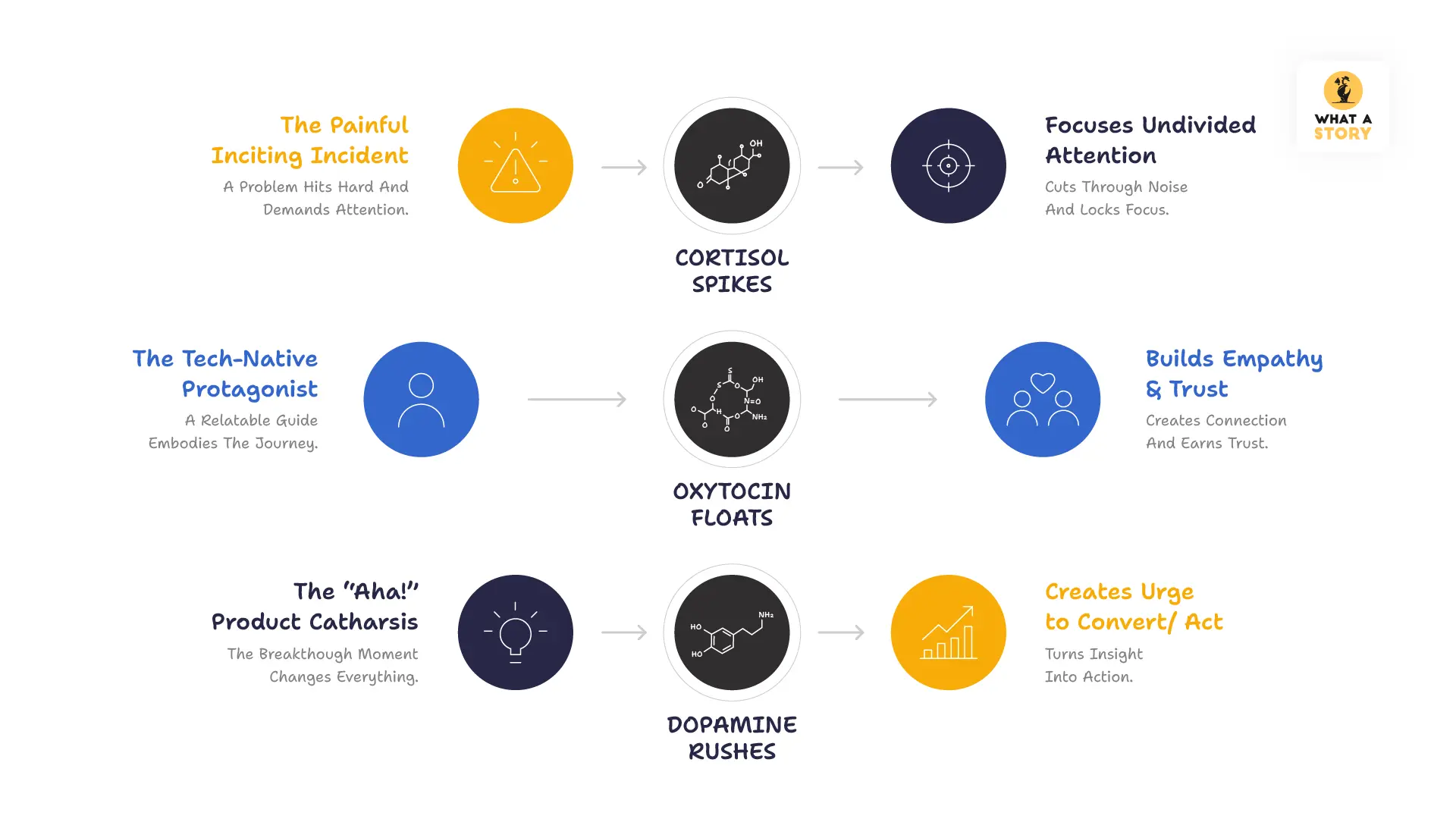
Cortisol - the attention grabber. Open with your logo and a generic tagline, and most viewers disengage within three seconds. Open with a specific, high-stakes operational bottleneck, and the brain releases cortisol - the chemical responsible for immediate, focused attention.
Oxytocin - the trust builder. When a buyer sees a relatable peer on screen - an overworked VP of Product, a stretched-thin Security Compliance Officer - the brain releases oxytocin, the chemical most closely tied to empathy. It's what makes someone think, unprompted, this company actually understands my day.
Dopamine - the reward. When the video introduces the solution and shows, concretely, how it resolves the chaos, the brain gets a dopamine hit. That hit is what gets your UI and your brand associated with relief rather than another decision to make.
2. Your Real Competitor Isn't Another Startup - It's the Status Quo
The fiercest competitor for your software isn't the other venture-backed startup on Product Hunt. It's inertia.
Status Quo Bias is the well-documented tendency to prefer the current state of affairs simply because change feels riskier than staying put - even when the current state is worse.
This bias is grounded in Prospect Theory, the framework Daniel Kahneman and Amos Tversky introduced in their 1979 paper as a descriptive alternative to classical expected-utility models of decision-making under risk.
Its central finding is loss aversion - people feel a loss roughly twice as intensely as they feel an equivalent gain (read the original Kahneman & Tversky paper).
Here's what that means for your script: when a B2B buyer watches your video, they aren't quietly admiring your feature set. Their subconscious is running a cost calculation - migration friction, security review, onboarding time, the personal risk of championing a tool that underdelivers.
None of that shows up if your script only talks about what the product does.
The fix is an antagonistic narrative. Your product isn't the center of the story - the buyer's current workflow is the villain. The script's job is to make staying the same feel more dangerous than switching, not the other way around.
3. Writing for a Buying Committee, Not a Single Buyer
B2C storytelling targets one person's ego, status, and identity. B2B SaaS storytelling has to satisfy a fragmented committee, and each member is running a different threat assessment in their head.
Generic, one-size-fits-all messaging is one of the most common ways founders undercut their own conversion rates and a script written for a single generic buyer runs into the same trap.
A single video now has to do the persuading that used to take three or four separate sales calls, which means it has to speak to all three personas at once, not just the loudest one in the room.
Miss any one of these three, and the video gets stuck in the approval chain, no matter how well the top-of-funnel messaging lands.
4. The Four-Part Script Blueprint
This is the structural arc we default to for cold-to-warm SaaS prospects. It's a repeatable pattern, not a rigid template - but the sequence itself is what does the psychological work.
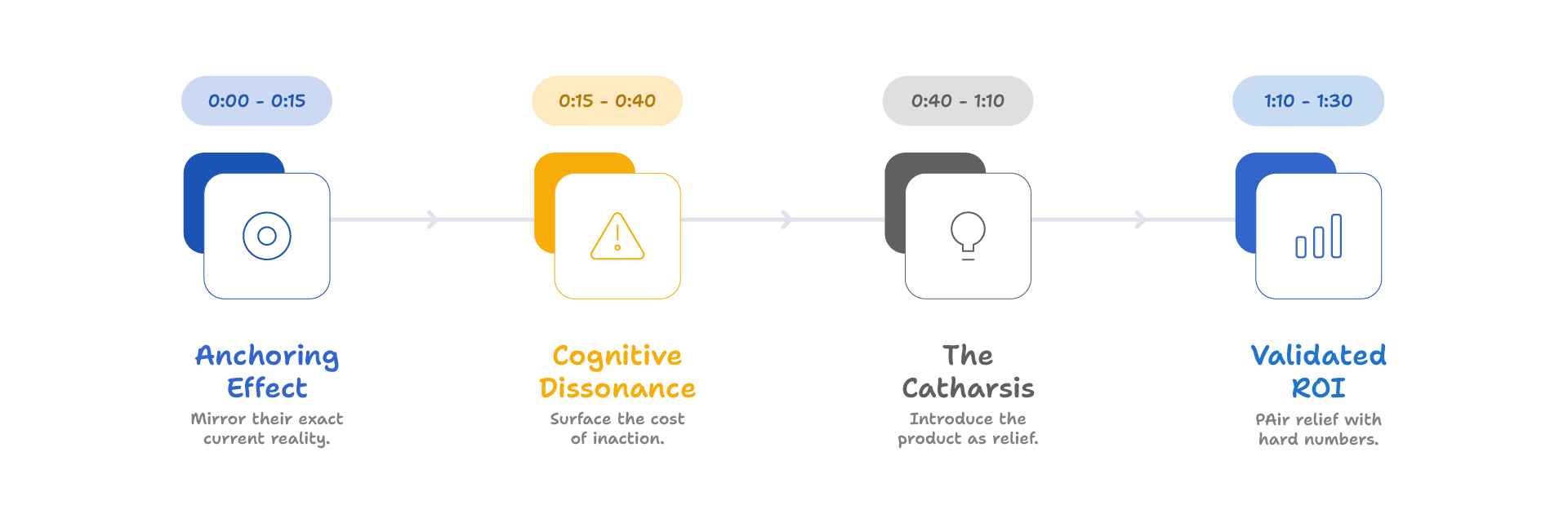
Phase 1 - The Anchoring Effect (0:00–0:15). Open in a highly specific, indisputable version of the buyer's current reality. Don't mention your company yet. The brain looks for patterns it recognizes, and mirroring the buyer's exact stack or workflow earns immediate cognitive buy-in.
Script example: "Building a custom ML model from scratch sounds great - until your data engineering team spends six months just cleaning raw data and fixing broken APIs."
Phase 2 - Cognitive Dissonance & the Cost of Inaction (0:15–0:40). Introduce the disruption. Surface the hidden cost of the current workaround - this is where the "villain" of the story shows up.
Script example: "Meanwhile, engineering talent is wasted on repetitive maintenance, product launches slip, and competitors are eating into market share."
Phase 3 - The Catharsis (0:40–1:10). Introduce the product - but the product is the lightsaber, not Luke Skywalker. The buyer is still the hero. This is where clean, purposeful UI animation earns its budget, because it's showing relief, not just showing off.
Script example: "That's why we built [Product]. It connects directly to your existing stack and automates data sanitization in minutes, so your team can focus on deploying models instead of debugging scripts."
Phase 4 - Validated ROI & the Transformed Future (1:10–1:30). Show the clean, post-resolution state, and pair the emotional relief with hard numbers so the analytical brain has something to point to when it justifies the decision internally.
This is also where the dopamine payoff from Phase 1's tension gets delivered. (For the math behind tracking this, our Strategic Guide to Explainer Video ROI for SaaS breaks down how to model signup lift, pipeline quality, and sales-cycle impact before you even start production.)
Script example: "Move from raw data to production-ready models 10x faster, cut infrastructure overhead by 40%, and scale securely. Stop wasting engineering hours - book your custom demo today."
Frequently Asked Questions
Why don't feature-focused SaaS videos convert, even with great animation?
Because they only engage the analytical brain, which is naturally skeptical and looking for reasons to say no. Without a narrative structure that builds tension and delivers relief, there's nothing to lower the viewer's defenses - no matter how polished the motion design is.
What is Status Quo Bias, and why does it matter for SaaS marketing?
It's the tendency to prefer the current state of affairs because change feels riskier than staying put, even when staying put is the worse option. In B2B software, it's usually the single biggest barrier to conversion - bigger than any competitor.
What is the difference between a product-centered script and an antagonistic narrative?
A product-centered script makes the software the hero. An antagonistic narrative makes the buyer's current workflow the villain and positions the product as the tool the buyer - the actual hero - uses to solve their own problem. The distinction changes how defensive the viewer feels while watching.
How long should a B2B SaaS explainer video script be?
The four-phase structure above maps to roughly 90 seconds, which lines up with typical SaaS explainer video length benchmarks. Longer isn't automatically better - the goal is complete narrative arc, not runtime.
Who should a SaaS explainer video script be written for if there are multiple stakeholders involved in the purchase?
All three at once: the end-user (who needs to see friction relief), the decision-maker (who needs ROI logic), and the gatekeeper (who needs a signal of security and stability). A script that only speaks to one persona tends to stall in the approval process even if it wins over the initial champion.
Don't Just Animate. Communicate.
Premium motion design and sleek visual styles give your brand undeniable credibility and authority. It ensures your software looks enterprise-ready, rather than like a half-baked weekend project. But never forget that visuals are the body; buyer psychology is the soul of the video.
When you stop writing scripts to show off your code and start engineering narratives that ease your buyer's professional anxieties, dismantle their loss aversion, and simplify their complex workflows, your videos will stop being a marketing expense and start functioning as a scalable sales engine that converts while your team sleeps.
Ready to turn your complex SaaS, Tech, or AI platform into a high-converting, psychologically engineered video story? Let’s skip the fluff and design an asset that actually drives ARR. Get a free consultation from What a Story experts today.
If you want a closer look at how this plays out step by step in production, our 7-step SaaS explainer video process walks through exactly how we take a script like this from strategy to final cut.