

Most founders think they have a positioning problem. They usually don't.
The product works. Customers genuinely benefit from it. The market exists. The team is highly capable.
Yet the website doesn't convert, demo requests stall, and prospects ask the same questions repeatedly: Wait, what exactly does your product do?
After working with startups and enterprise brands to script explainer videos, product demos, and launch narratives, we've noticed a recurring pattern: founders are often the worst people to write their own product messaging.
Not because they lack expertise, but because they have too much of it.
They know every feature, every technical breakthrough, and every customer request that shaped the product. But customers don't see that journey.
They encounter a homepage, a landing page, or a sales pitch and decide in seconds whether it's worth their time.
Recent data shows that B2B buyers establish their shortlist incredibly early in the buying journey, with up to 95% ultimately purchasing from that initial list. (Source)
The irony is hard to ignore: The people most qualified to build the product are often the ones who unintentionally make it harder to buy.
The Founder Messaging Trap
Psychologists refer to it as the curse of knowledge. Once you understand something deeply, it's difficult to imagine what it's like not to understand it.
Founders know:
- Why a feature was prioritized.
- How their product differs from competitors.
- The advanced terminology customers "should" understand.
- The deep technical complexity hidden beneath a simple interface.
Customers know none of that. They arrive with an immediate problem, limited time, and dozens of alternatives competing for their attention.
Research from Forrester found that nearly 90% of B2B buyers experienced stalled purchasing decisions due to increasing complexity and information overload.
The last thing buyers need is messaging that creates more friction. This is exactly where many founders unintentionally sabotage their own growth.
Mistake #1: Talking About Features Instead of Outcomes
Founders love features because features represent effort: months of development, late-night product sprints, and difficult engineering decisions.
But customers don't buy effort. They buy outcomes. Consider these two examples:
- Feature-focused messaging: Help your operations team eliminate repetitive work and make faster decisions without increasing headcount.
- Outcome-focused messaging: Help your operations team cut manual data entry by 40% and approve vendor invoices in minutes, not days - without adding to your headcount.
Both describe the exact same product. Only the second one answers the question every buyer is silently asking: How does this quantifiably improve my life or business?
One exercise we use while developing scripts is deceptively simple. For every feature you mention, ask yourself:
- So what?
- Why does that matter?
- What business outcome does it actually create?
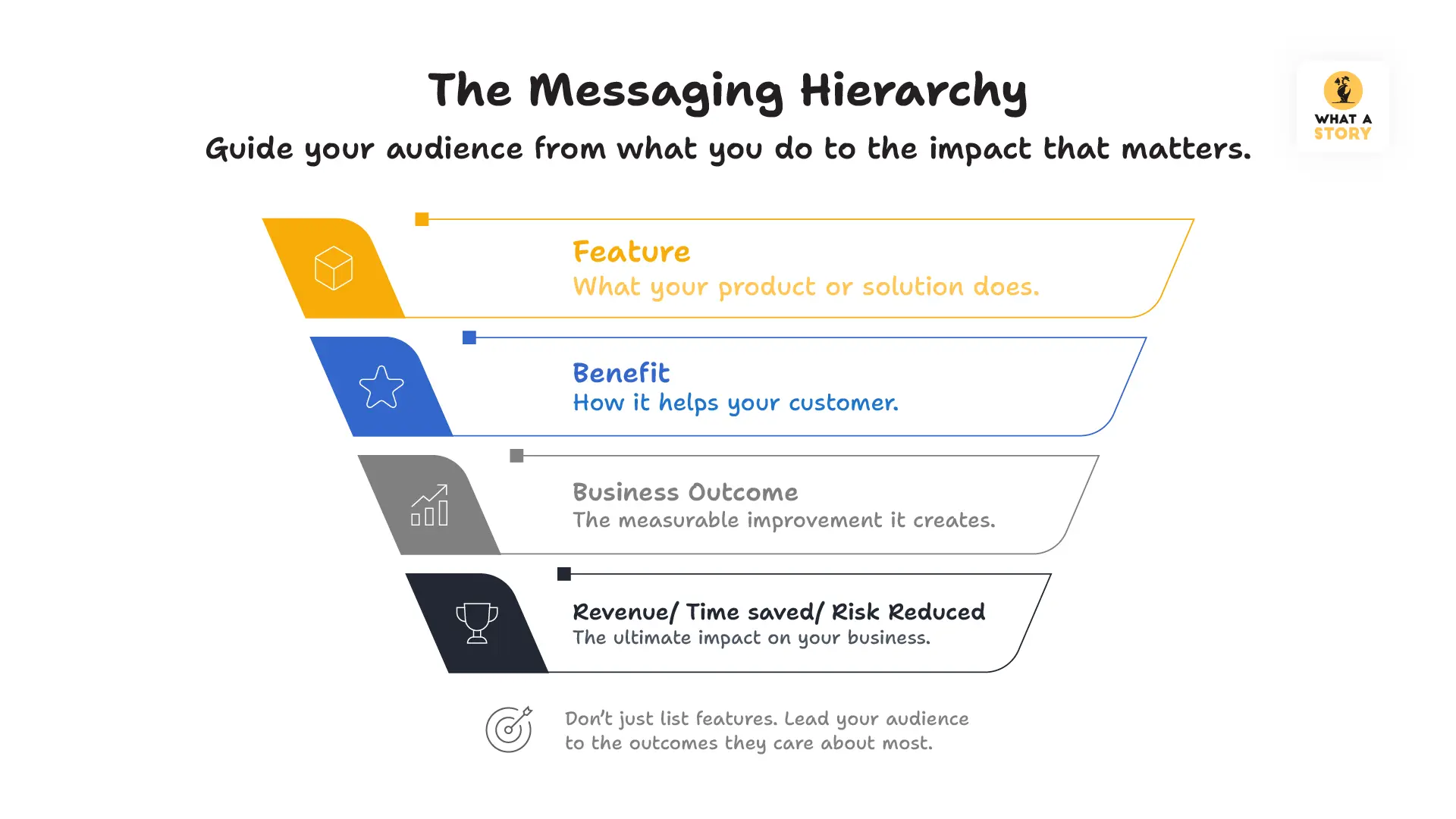
Feature → Benefit → Outcome. That is the messaging hierarchy customers actually care about.
Mistake #2: Assuming Customers Speak Your Language
One of the fastest ways to lose a prospect is to make them work too hard to understand what you do.
Because generative AI and automation are moving so fast, founders frequently fall into the trap of using dense, trending tech acronyms. Today, we see home page littered with phrases like:
- Autonomous agentic workflows
- Hyper-personalized LLM context layers
- Cognitive workflow orchestration
- Predictive intent-data infrastructure
These terms aren’t technically wrong, but they are highly ineffective. Your customers don't think in tech architecture; they think in daily frustrations.
When you use heavy jargon, you force the prospect to play translator. If they have to guess what you mean, they will click away.
The Rule of Clarity: Simple messaging doesn't make your product sound less sophisticated. It makes your expertise accessible.
The 30-Second Stranger Test
To see if you are trapped in your own industry language, ask someone completely outside your tech bubble to spend 30 seconds on your homepage. Then, ask them three questions:
- What does this company do?
- Who is it for?
- Why should someone care?
If they struggle to answer, your messaging needs work. The strongest video scripts emerge when we aggressively strip away the buzzwords and shift the conversation toward absolute customer clarity.
The way you communicate matters just as much as what you communicate. Our guide on Where to Place Explainer Videos explores how strategic storytelling helps simplify complex ideas and improve comprehension.
Mistake #3: Trying to Speak to Everyone
Broad messaging feels safe, but it isn't. A startup targeting healthcare providers, SaaS companies, fintech brands, manufacturers, and educational institutions all on the same page ends up sounding completely generic.
Compare these examples:
- Broad: Helping businesses transform operations through innovative technology.
- Specific: Helping growing SaaS teams reduce onboarding bottlenecks through automated implementation workflows.
The second feels inherently more relevant because it describes a recognizable problem. Specificity creates trust. People pay attention when they feel uniquely understood.
Positioning expert April Dunford often emphasizes that context helps customers recognize value. If buyers don't know exactly who your solution is for, they will struggle to understand why they should choose you over a legacy giant.
Mistake #4: Making the Product the Hero
Customers don't wake up thinking about your product. They think about their own real-world headaches: missed deadlines, inefficient processes, frustrated teams, declining retention, and pressure from leadership.
Your messaging should always begin there.
- Instead of saying: We built an innovative AI-powered platform.
- Try saying: Your customer success team shouldn't spend half its day answering the same repetitive questions.
The first statement talks about you. The second talks about them.
The strongest product demos follow this exact principle.
As we discuss in our Product Demo Videos Guide, effective demonstrations don't start with buttons and features. They start by framing the customer's problem and showing what life looks like after it's solved. People buy better outcomes, not product specifications.
Mistake #5: Constantly Changing the Story
Startups evolve quickly, but your core messaging shouldn't change every quarter just because a competitor updated their website, a new investor joined, or a minor feature launched.
While iteration is important, constant pivoting creates market confusion. If your ads promise efficiency, your homepage focuses on innovation, and your sales team emphasizes customization, prospects receive three completely different stories. Confused buyers rarely convert.
Instead, establish a rock-solid messaging foundation built around:
- Who you serve.
- The exact problem you solve.
- The quantified outcome you deliver.
- Why is your approach uniquely different?
- Absolute proof that it works.
Your product features will evolve, but your core story should always remain recognizable.
The 4C Messaging Test
Over time, we've found that effective, high-converting messaging must answer four fundamental questions:
- Context: Can customers immediately recognize the situation you're describing? If they don't see themselves in the problem, they won't care about the solution.
- Consequence: What happens if the problem remains unsolved? (e.g., Lost revenue, wasted engineering hours, operational bottlenecks). Help them understand what is truly at stake.
- Change: What becomes possible after adopting your product? Describe the concrete, positive transformation.
- Credibility: What is the immediate, un-fakeable proof that your product actually delivers this change? In a market full of AI hype, you must back up your claims instantly with a 30-second unedited product clip, an interactive walkthrough, or hard case study metrics.
Founder Language vs. Customer Language
Why This Matters Beyond Your Website
Strong messaging improves every single touchpoint of your business:
- Explainer videos become easier to script.
- Product demos become effortless to follow.
- Sales conversations become highly productive.
- Product launches become memorable and impactful.
For example, our article on Template vs Custom Videos: Which Is Best for Your Brand? highlights how early communication choices heavily influence audience perception.
Similarly, our collection of Best Product Launch Video Examples demonstrates how the most successful launches focus entirely on customer transformation rather than feature overload.
Messaging isn't just a marketing exercise. It is a fundamental business advantage.
Final Thoughts
Founders don't ruin product messaging because they don't care. They struggle because they've lived inside the product for too long. They remember the roadmap debates, the engineering breakthroughs, and the countless back-end iterations that customers will never see.
But customers don't buy your journey. They buy the possibility of solving a problem that is slowing them down today.
The companies that win aren't always the ones building the most sophisticated technology. They are the ones that make understanding it completely effortless.
Need Help Clarifying Your Product Story?
If your team is struggling to explain what makes your product valuable in today's crowded market, you're not alone.
At What a Story, we help startups and enterprise brands turn complex products into narratives customers actually understand - through animated explainer videos, product demo videos, and launch stories designed to drive real action.
Sometimes, the challenge isn't the product. It's the story around it. Get in touch with us today.
FAQs
What are the most common product messaging mistakes?
Founders often focus too heavily on technical features, abuse modern AI jargon, try to target too many audiences at once, position their product as the hero instead of the customer, and change their narrative too frequently.
Why does product messaging fail?
Product messaging fails when companies communicate from an internal perspective (what we built) instead of addressing external customer realities (the problems, desired fiscal outcomes, and immediate buying motivations).
How can startups improve their product messaging?
Startups can drastically improve their messaging by running external user tests, aggressively removing buzzwords, tying value to quantifiable outcomes (time, money, or risk), and placing un-fakeable social proof right alongside their main headlines.
What's the difference between product positioning and product messaging?
Positioning defines where your product fits within the competitive market landscape. Messaging translates that strategic positioning into clear, human language that customers understand and act upon.
How often should companies update their product messaging?
Your core brand narrative and customer definition should remain stable, while your supporting value propositions can evolve based on direct customer feedback, macroeconomic shifts, and major product milestones.


