
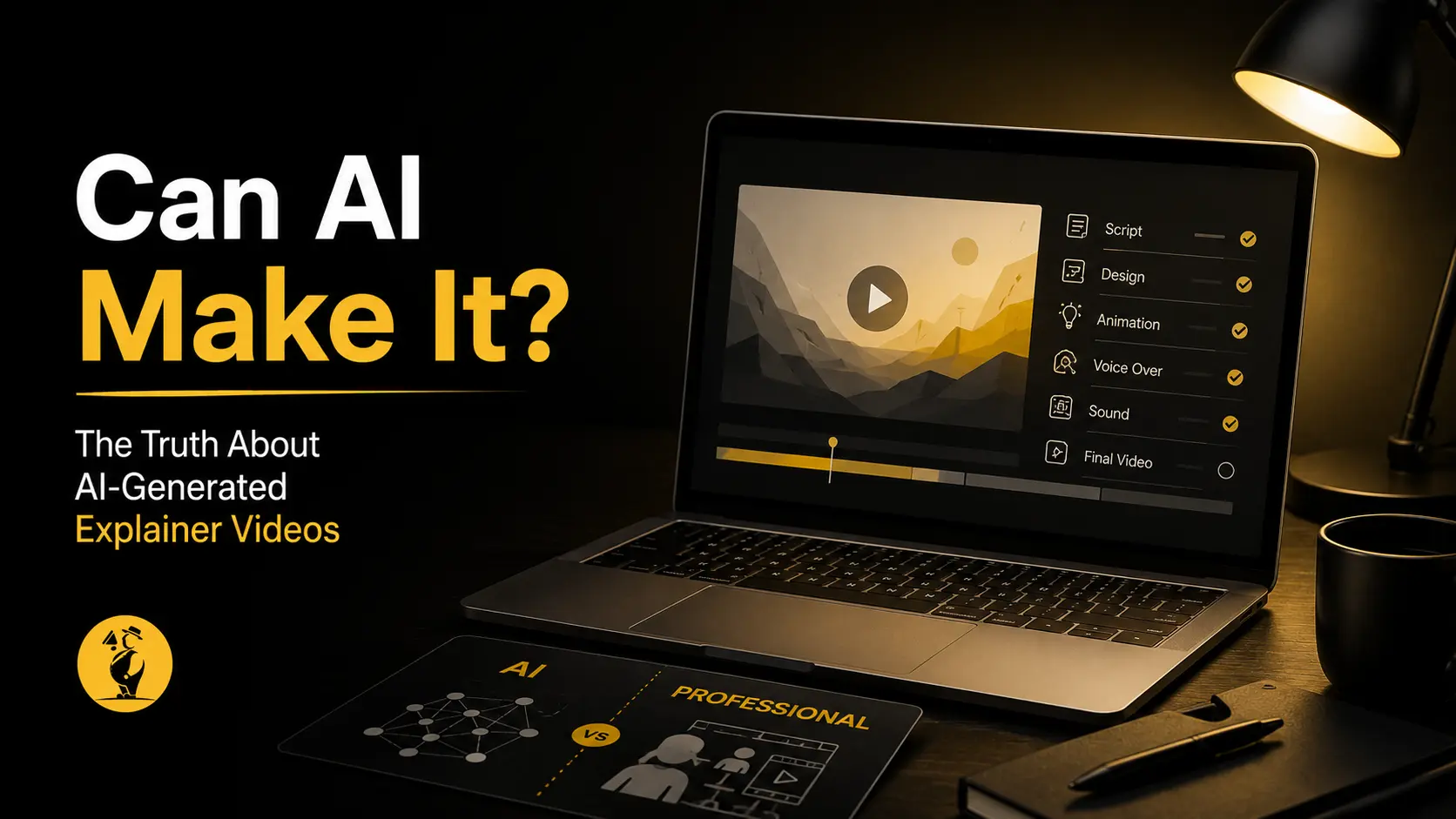
Yes - but the answer depends on what you mean by "professional."
Today, AI can create a good explainer video in minutes. However, if you're looking for a video that represents your brand, converts customers, and looks premium, AI alone still has limitations.
Here's a comparison:
What AI Can Do Well
Modern AI tools can speed up several parts of video production.
They can help with:
- Generating script ideas
- Creating rough storyboards
- Producing AI voiceovers
- Generating stock-style visuals
- Creating simple animations
- Translating videos into multiple languages
For straightforward projects, these capabilities can save both time and cost.
Where AI Still Falls Short
Creating a professional explainer video involves more than assembling visuals.
AI often struggles with:
- Building a clear story from a complex product
- Understanding your brand personality
- Creating original visual concepts
- Explaining technical products accurately
- Maintaining consistent design throughout the video
- Making creative decisions based on your audience
The biggest difference isn't the animation - it's the strategy. A professional explainer video involves understanding the audience, simplifying complex ideas, writing a persuasive script, designing a unique visual style, and carefully pacing the story.
When AI Is a Good Choice
AI-generated videos can work well if you need:
- Internal training content
- Product updates
- Social media clips
- Early product concepts
- Quick presentations
- Draft versions for feedback
In these cases, speed may be more important than originality.
When Professional Production Is Worth It
A custom production process becomes more valuable when the video will represent your business publicly.
Examples include:
- Product launch videos
- Homepage explainer videos
- Investor presentations
- Sales enablement content
- Enterprise marketing campaigns
- Brand awareness initiatives
These videos often require stronger storytelling, custom visuals, and careful attention to brand consistency.
A Practical Approach
Many companies don't choose between AI and professional production.
Instead, they combine both.
For example:
- Use AI to brainstorm ideas.
- Refine the messaging with your marketing team.
- Work with a production team to develop the final script, visuals, and animation.
This approach can reduce planning time while maintaining production quality.
Related reading: If you're evaluating AI beyond video production, you may also find our guide on where AI fails in marketing content useful. It explains why AI often struggles with messaging, brand voice, audience understanding, and strategic communication—the same challenges that affect AI-generated explainer videos.
Common Misconception
Some businesses assume AI automatically reduces production costs.
That's not always true.
If an AI-generated script requires major revisions, or if generic visuals don't communicate your product effectively, the time saved at the beginning may be lost during revisions.
The quality of the input and the review process still matter.
Frequently Asked Questions
Can AI replace an explainer video agency?
Not completely. AI can automate certain tasks, but strategy, creative direction, and custom storytelling still rely heavily on human expertise.
Are AI-generated voiceovers good enough?
They've improved considerably and may be suitable for some projects. However, professional voice actors often provide greater emotional range and natural delivery for customer-facing videos.
Can AI create custom animations?
AI can generate animations, but highly customized visual styles and brand-specific illustrations usually require manual design and animation.
Should startups use AI for explainer videos?
AI can be useful for early concepts or limited budgets. As the business grows and marketing requirements become more demanding, many startups move toward custom production.
Final Thoughts
AI is changing how explainer videos are planned and produced, but it hasn't removed the need for strategy, creativity, or clear communication.
The strongest results often come from using AI where it adds efficiency while relying on human expertise for the decisions that shape the final story.
The goal isn't simply to produce a video quickly - it's to create one that explains your product clearly and supports your business objectives.


