

I spend a lot of time in sales conversations.
My job is understanding why deals move and why they stall. Why a prospect goes quiet after a promising first call. Why a sales cycle that should take three weeks takes three months.
Why a product that everyone who uses it loves is somehow still a difficult sell.
After years in this role at What a Story, I've developed a very specific view on where sales friction actually comes from. It almost never comes from where founders think it does.
Founders tend to attribute stalled deals to pricing objections, competitive alternatives, or timing. Those things are real. But in my experience, the most common reason a qualified prospect doesn't convert is simpler and more fixable than any of those:
They didn't understand the product well enough to justify the decision internally.
Not to themselves. They got it. They were on the call. They saw the demo. They asked the right questions and got good answers.
The problem is the five other people they have to convince before anything gets signed.
The Real Shape of Sales Friction
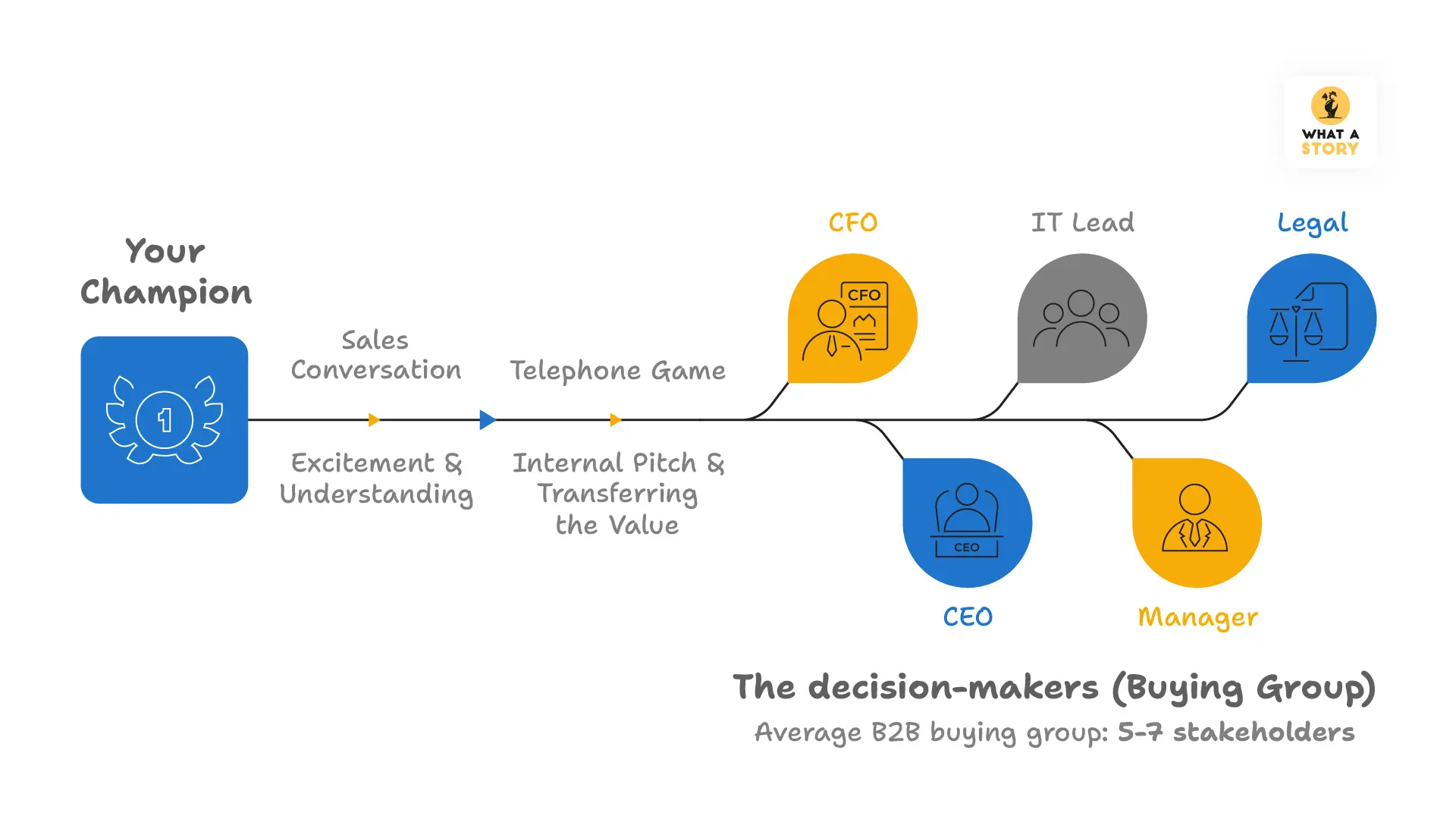
In SaaS and B2B tech, almost no buying decision is made by one person.
The person you're selling to, the champion, the one who found you, got excited, booked the call, is almost never the person who writes the cheque.
They have to sell it internally. To their manager, their CFO, their IT lead, their legal team, their CEO. Sometimes all five.
And here's the friction: you were on those calls with your champion. You answered every question. You walked them through the product. You built the relationship and the credibility.
But you're not in the room when they try to explain it to their CFO.
Your champion walks into that room with a slide deck they put together at 10pm the night before, a vague memory of the demo, and the genuine enthusiasm of someone who believes in the product.
They face a CFO who has twelve budget decisions to make this quarter and approximately four minutes of attention to give this one.
Three things happen:
The explanation is incomplete.
The value isn't clear.
The CFO asks a question the champion can't fully answer.
And the deal goes into "we need to revisit this next quarter."
That's sales friction.
It's the gap between the champion's understanding and their ability to transfer that understanding to the people who actually control the decision.
How Video Solves The Internal Selling Challenge (The Gap Sales Reps Can't Fill)
I want to be precise about this because the claim is often overstated.
A video does not replace a sales rep. It does not build a relationship. It cannot answer a specific objection in real time or respond to the particular anxieties of a specific enterprise buyer on a specific Tuesday.
What a video does and does better than any sales rep in any conversation is deliver a consistent, controlled, emotionally compelling explanation of the product to every single person in the buying process, regardless of when and where they encounter it.
Think about what that means in practice.
Your champion watches a well-built product video before their first call with your team. They arrive already understanding the core value proposition.
The first call skips the basic explanation phase and goes straight to qualification and specifics. That call is more productive. It moves faster. It produces clearer next steps.
Then your champion shares the video with their manager before an internal meeting. The manager arrives at that meeting with context. They ask more informed questions. The meeting has a higher ceiling.
Then the video goes to the CFO. And the IT lead. And whoever else needs to be part of the decision. Each of them gets the same story, told the same way, with the same clarity and the same emotional arc.
Nobody's version of your product is better or worse than anyone else's. Nobody's understanding is missing a key piece because the champion forgot to mention it.
That consistency, the ability to put the same explanation in front of every decision-maker in the buying group is something no sales rep, however good, can replicate at scale.
And it's worth more to a sales cycle than most teams realise until they measure it.
The asynchronous advantage: Selling while you sleep
Beyond consistency, there is the matter of timing. In 2026, the B2B buying landscape has shifted - Gartner reports that 75% of B2B buyers now prefer a rep-free sales experience. Modern buyers are "rep-shy"; they often don't want to hop on a Zoom call just to understand your basic features.
A video allows them to "buy" on their own terms. Whether it’s a CFO reviewing your pitch at 11 PM or a Tech Lead vetting your security at 6 AM, video acts as your most tireless sales rep.
It provides a high-fidelity, asynchronous experience that respects the buyer’s schedule while moving the deal forward without a single calendar invite."
The Pre-Call Video: The Highest-Leverage Shift I've Seen
Of all the ways we've seen product videos reduce sales friction across 650+ client companies, the single highest-leverage change is the one that sounds the most minor: sending a short video before the first sales call.
A ninety-second video that does three specific things
- Names the viewer's problem accurately,
- Shows the product addressing it,
- And sets up the conversation that's about to happen.
The effect on first calls is measurable and consistent. When a prospect has watched a pre-call video, the call dynamic changes completely. They arrive already having self-selected.
They know enough about the product to know it's relevant to them which means the call isn't a discovery session, it's a qualification conversation.
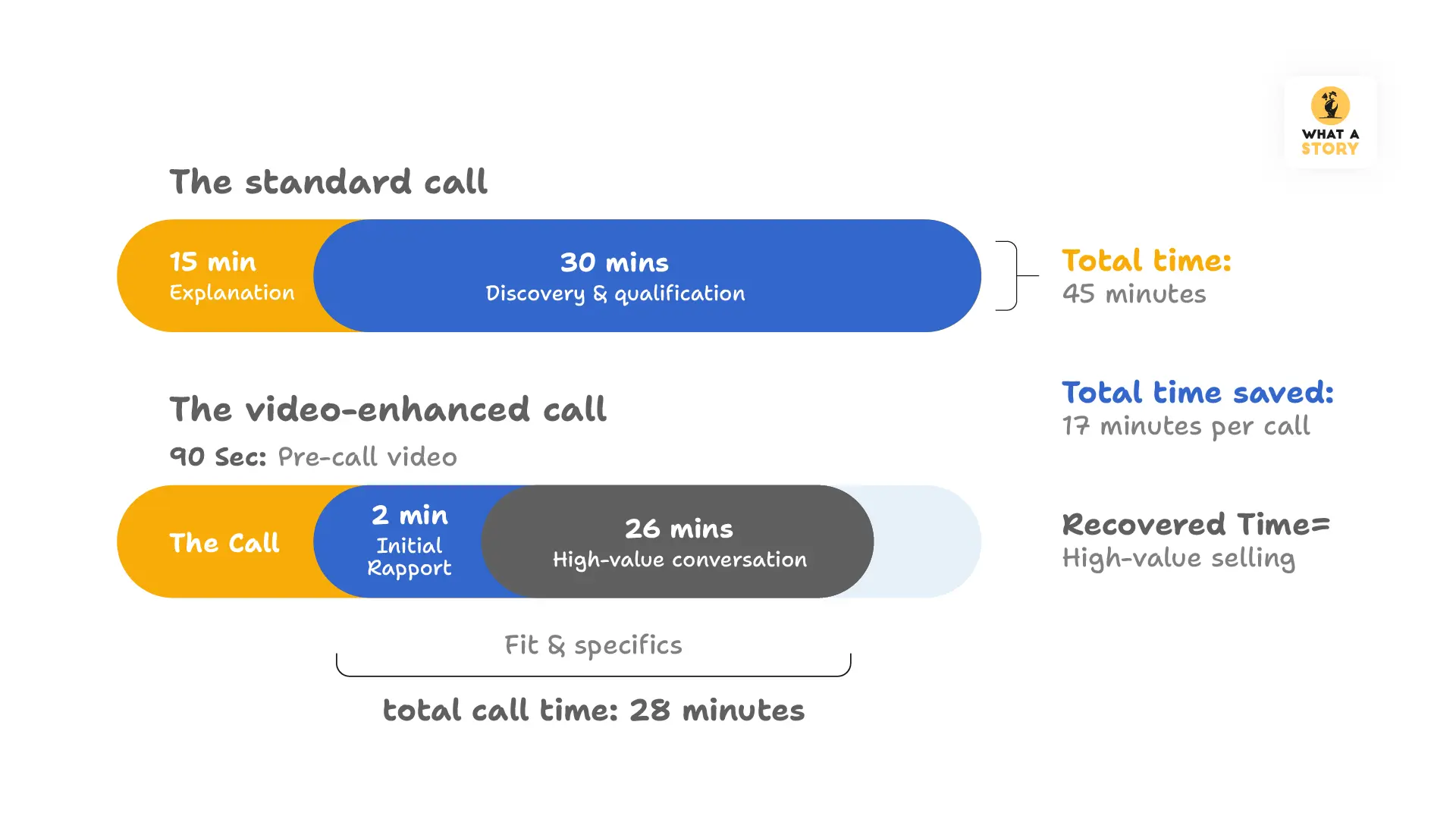
The rep isn't spending the first fifteen minutes explaining what the product is. They're asking about fit, timeline and specific needs from minute one.
We worked with a sales-led SaaS company whose average first call was running forty-five minutes.
A significant portion of that time was spent on basic product explanation, the same explanation, on every call, regardless of the prospect's background or context.
After implementing a pre-call video sent to every booked prospect, average first call length dropped to twenty-eight minutes. The explanation that used to take fifteen minutes was arriving before the call.
The call itself became a different conversation, of higher value, faster moving, more likely to produce a clear outcome.
That's seventeen minutes per call. Multiplied across a sales team of six reps running eight calls a week. The arithmetic on recovered time is significant. But the impact on conversion rate because shorter, more focused calls produce clearer next steps was more significant still.
The Video That Survives the Internal Meeting
There's a conversation I have regularly with sales leaders at the companies we work with. They describe a version of the same situation: a promising deal that goes quiet after a strong first call, only to come back weeks later stalled, confused, or lost.
When we trace those deals backwards, they almost always die in the internal meeting, the conversation where the champion tried to explain the product to stakeholders who weren't on the original call.
The champion is not the problem. The champion is enthusiastic, knowledgeable, and motivated. The problem is that human beings are unreliable vessels for product information. We remember what resonated with us personally.
We forget the parts that didn't feel relevant in the moment. We explain things in our own language, which may not be the language that lands for a CFO or an IT lead.
A video survives the internal meeting because it doesn't depend on the champion's memory or communication style.
When a champion can say "let me show you the video" rather than "let me explain what I saw," the message that reaches the CFO is the same message that moved the champion. The emotional arc is intact.
The value proposition is clear. The specific outcome, the one that made the champion think "we need this" lands the same way it did the first time.
We've had sales leads tell us, months after delivery, that a video they almost didn't commission was the thing that closed their largest deal of the year. The video was in the room when they weren't.
Where Video Reduces Friction at Every Stage
Sales friction doesn't only exist at the decision stage. It exists at every point in the buying journey and a well-deployed video library addresses each one.
At awareness: A prospect encounters your product but doesn’t understand why it’s relevant to them. A homepage explainer that opens on their specific frustration removes this friction before a sales rep is ever involved.
Look at our client Fronter, for example. By using a custom explainer video to simplify their core message, they destroyed market friction and drove over 1.25M engagements. They didn’t just explain their product; they captured the market’s attention at a scale that traditional sales outreach never could.
Watch the Fronter Onboarding Video here
At consideration: A prospect is evaluating you alongside two competitors. They're trying to understand the difference in outcomes.
A specific use-case video that shows exactly how your product addresses their category of problem makes that distinction visible without requiring a rep to explain it on a call that may never happen.
At internal approval: The champion needs to convince stakeholders. This is the friction point we've already discussed and it's the one that kills the most deals that should close.
A short, shareable video built specifically for internal stakeholders, addressing the questions a CFO or IT lead would ask, changes the internal meeting from an explanation session into a decision session.
At onboarding: The deal is closed, but new users encounter the product without context. Friction here produces slow adoption, low engagement, and eventual churn.
A well-structured onboarding video that shows the "core workflow" and narrates the outcome gets new users to their first "Aha!" moment faster.
By replacing dense manuals with a 90-second walkthrough, we've seen companies effectively halve their support ticket volume in the first 30 days. It turns a "how-to" struggle into a "fast-value" win.
At expansion: An existing customer needs to understand a new feature or a broader product suite before they'll consider an upsell conversation.
A two-minute product update video sent before a renewal call does the same thing a pre-call explainer does: it makes the conversation more productive by removing the explanation phase from the call itself.
The Number Nobody Tracks But Should
Most companies measure video performance with view counts and watch-through rates. Both are useful. Neither tells you what you actually need to know.
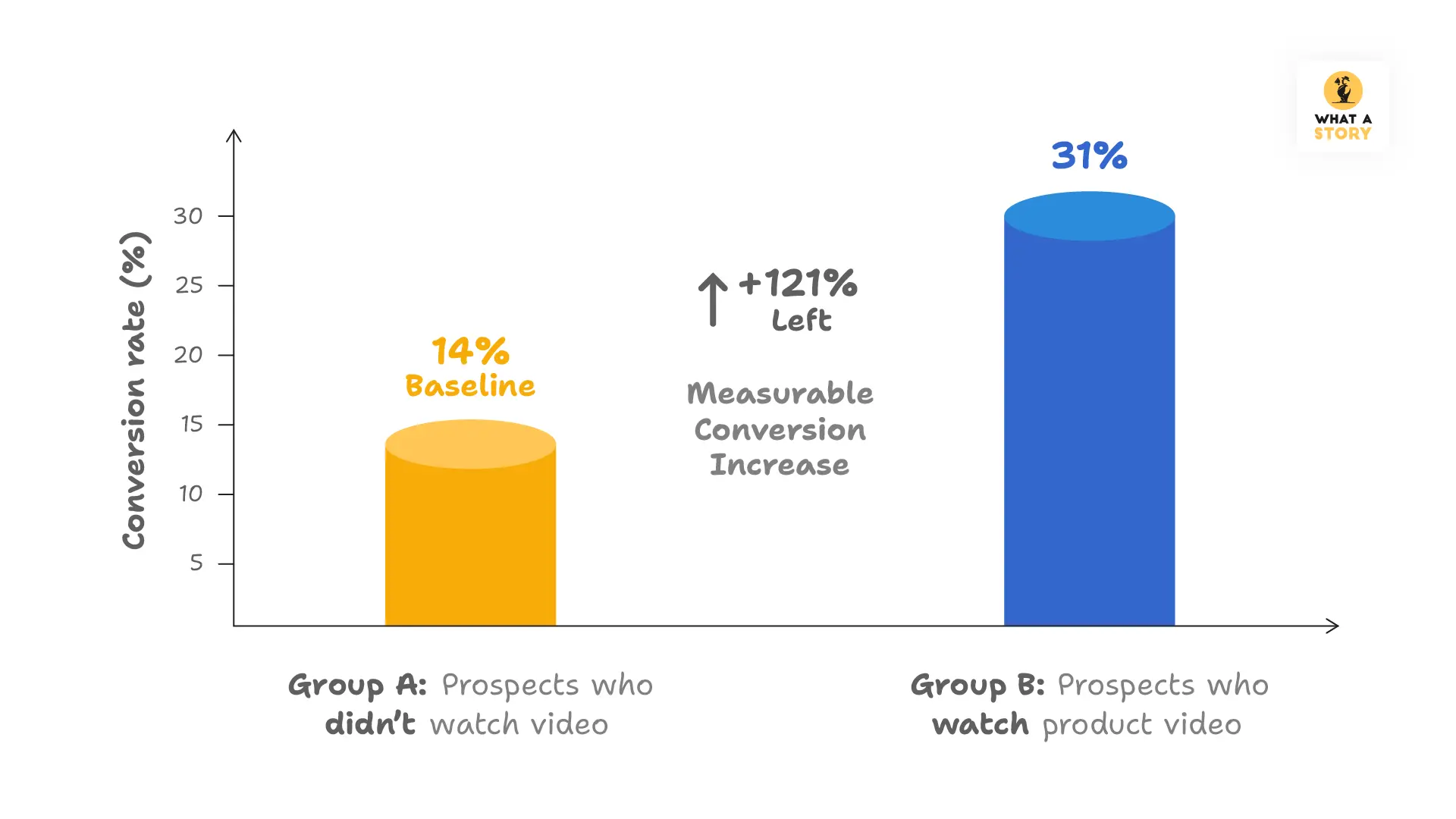
The number that matters is the conversion difference between prospects who watched a video and prospects who didn't.
The specific lift in conversion rate when a video is part of the buyer's journey versus when it isn't.
In our experience working across hundreds of SaaS sales cycles, that number is consistently significant and consistently underestimated before it's measured.
Companies that track it discover that prospects who watched a product video before a sales call convert at a higher rate, close faster and generate fewer support queries post-onboarding.
That last point is worth dwelling on. Lower support queries after close means the video did something beyond closing the deal, it set accurate expectations. It told the buyer what the product actually does, so that when they use it, the reality matches the promise. That alignment is where long-term retention begins.
Moving from "One Video" to a Sales Enablement Library
The biggest mistake founders and sales leaders make is thinking of video as a "one-and-done" marketing project. To truly destroy sales friction at scale, you don't just need a single homepage video; you need a Sales Enablement Video Library.
Think of this as a modular toolkit for your revenue team. Instead of forcing a prospect to sit through one long, bulky presentation, your reps can "pull a video from the shelf" to answer a specific concern in real-time.
A robust library includes:
- Pre-call "Hype" Videos: Sent 24 hours before a demo to build excitement and set the stage.
- Feature Deep-Dives: Short, 60-second clips that resolve technical blockers for IT or Product leads.
- Micro-Case Studies: Rapid-fire social proof tailored to the prospect's specific industry.
When your team has these assets at their fingertips, you aren’t just selling - you’re building a repeatable revenue engine. You stop relying on the individual "brilliance" of a rep and start relying on a high-performing system.
What This Means for How You Think About Video
Most companies think about product videos as marketing assets. Something you put on your homepage, run as an ad, maybe share on LinkedIn.
The companies that get the most measurable value from video think about it differently. They treat video as a sales infrastructure investment, something that makes every part of the revenue process more efficient, from first touch to close to retention.
The question worth asking is not 'do we need a video?' The question is: at which specific point in our sales cycle is the most friction created by people not understanding our product?
Answer that honestly, map the drop-off points, identify the deals that stalled and trace backwards, count the calls that spend the first fifteen minutes on explanation that should have happened before the call and you have the brief for the video that will do the most work for your business.
It might be a pre-call explainer. It might be an internal stakeholder video. It might be an onboarding sequence. It might be all three at different stages of your growth.
But the friction is specific. The video that removes it can be too.