



SaaS marketing strategies are incomplete without videos today, it has become an integral part of it now. However, the use cases differ across industries. For instance, an AI product may need to show the unfamiliar workflows whereas FinTech or a cybersecurity one would need to explain complex processes or product functionality.
This analysis looks at how ten major SaaS categories use video, supported by industry research, SaaS community discussions, and What a Story's own dataset of 1,315 categorized videos produced between 2015 and July 2026.
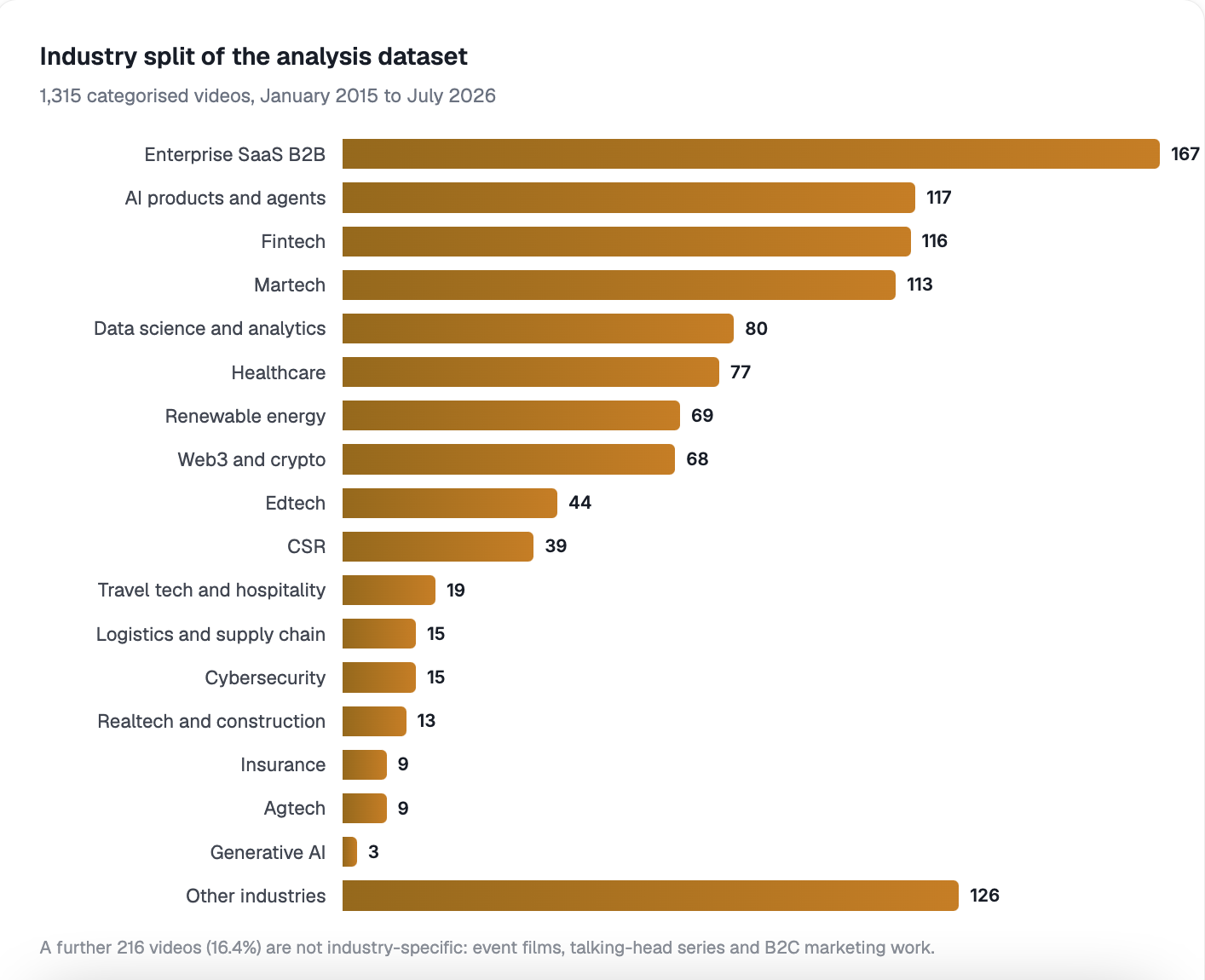
In our dataset, the largest category is Enterprise SaaS B2B that represents 167 videos, followed by AI products and agents (117), FinTech (116), and MarTech (113).
Why Video Usage Differs Across SaaS Industries
SaaS products can be difficult to explain because the product itself is often intangible.
It's not possible for a user or a visitor to see a security platform actually detecting a threat in the backend, an AI model processing a request, or a payment platform moving money between systems.
While the website copy and description can explain these processes, a well-made video can show the sequence visually.
This is reflected in broader video research. Wistia's 2026 State of Video Report, based on a survey of more than 900 professionals and analysis of more than 13 million videos, identifies product videos, educational videos, social videos and webinars among the formats receiving significant attention from marketing teams.
And where on the website does the video receive the highest play rates as per the report? The homepage and product pages.
But broad video statistics do not explain how different SaaS categories use video. The communication problem changes from one industry to another.
SaaS Video Usage by Industry
1. AI SaaS
AI SaaS products often introduce technology that potential customers may not fully understand before seeing it in action. Status copy on a website or a product description alone cannot explain terms such as AI agents, automation, machine learning, generative AI, AI workflows and model-based systems.
As above image, Our client dataset includes 117 videos for AI products and agents, making AI the second-largest category after Enterprise SaaS B2B.
For these products, video can demonstrate a simple sequence:
Input → AI processing → Output → Business result
Instead of telling a prospect that an AI platform automates a process, a video can show the process before and after the software is introduced.
Common video uses
- Product demonstrations
- AI workflow demonstrations
- Explainer videos
- Feature launch videos
- Use-case videos
- Customer stories
- Tutorials
Wistia's 2026 research also found that teams using AI were more likely to create product videos, which supports the growing relationship between AI products and demonstration-led video content.
What works best for AI SaaS?
For many AI products, the product itself should be visible early.
The viewer needs to understand:
What goes into the system?
What does the system do?
What comes out?
A video that only discusses the technology without showing the product may leave the same questions unanswered as the website copy.
2. Cybersecurity SaaS
Cybersecurity has one of the more difficult product communication problems in SaaS.
Much of the value of a security platform is invisible.
A security product might detect suspicious behavior, monitor endpoints, identify vulnerabilities, prevent attacks or analyze network activity. The buyer does not necessarily see those processes happening.
Our dataset contains 15 cybersecurity videos. While this is a smaller share of our production dataset, cybersecurity products present a distinct video communication challenge because much of their functionality happens behind the scenes.
Video can turn those invisible processes into a visual sequence.
Common video uses
- Product explainers
- Security workflow demonstrations
- Platform demos
- Threat detection videos
- Feature explainers
- Security architecture videos
- Customer stories
- Sales enablement videos
The audience also creates another challenge.
A cybersecurity product may be evaluated by a security engineer, while the final buying decision may involve a CIO, CISO, procurement team or business executive.
The video therefore has to make technical functionality understandable without assuming that every viewer has the same technical background.
What works best?
A strong cybersecurity video often follows this basic logic:
Problem → Threat → Detection → Product response → Business outcome
The purpose is not simply to show an attractive interface. It is to make an otherwise invisible security process easier to understand.
3. FinTech SaaS
FinTech products frequently deal with processes that are difficult to see.
Examples include:
- Payments
- Fraud detection
- Credit assessment
- Banking infrastructure
- Identity verification
- Investment workflows
- Financial reporting
- API-based transactions
Our client dataset includes 116 FinTech videos, placing FinTech almost level with AI and MarTech in our production history.
A video can turn these processes into a visual journey.
Customer initiates payment → platform verifies transaction → risk is assessed → payment is processed
That can be easier to understand than several paragraphs describing the same process.
FinTech video content is also frequently used for product education, onboarding, demonstrations and trust-building because customers may need to understand both how the product works and why they should trust it.
Common video uses
- Product explainers
- Product demonstrations
- Payment workflow videos
- App demonstrations
- Feature explainers
- Onboarding videos
- Security and compliance education
- Customer stories
You can also explore these FinTech video examples to see how complex financial products and workflows can be explained through different video styles.
4. MarTech SaaS
MarTech products often connect several marketing activities into one workflow.
For example:
Customer data → segmentation → campaign → automation → reporting
Our dataset includes 113 MarTech videos, making it one of the largest categories in our analysis.
A product screenshot can show the interface, but video can demonstrate how those different components work together.
Common video uses
- Product demos
- Workflow demonstrations
- Feature videos
- Integration videos
- Campaign examples
- Customer stories
- Educational videos
MarTech companies also have an interesting relationship with video because video itself is frequently part of their customers' marketing strategy.
The buyer may therefore understand video as both a marketing format and a product demonstration method.
What works best?
For MarTech, showing a complete workflow can be more useful than listing individual features.
Instead of: “Our platform includes automation, segmentation and analytics.”
The video can show: “Here is what happens when a marketer uses all three.”
5. HRTech SaaS
HR technology is often organized around business processes rather than technical infrastructure.
Examples include:
- Recruiting
- Employee onboarding
- Payroll
- Performance management
- Benefits
- Workforce management
- Employee engagement
This makes scenario-based video particularly useful.
Instead of explaining a feature in isolation, the video can show an HR team using the product to solve a familiar problem.
Common video uses
- Product walkthroughs
- Employee onboarding videos
- Feature explainers
- HR workflow demonstrations
- Customer stories
- Training videos
For example, an HR platform could demonstrate:
New employee joins → HR creates employee profile → documents are completed → onboarding tasks are assigned → manager tracks progress
That gives the viewer a clear understanding of the product's role in the process.
6. HealthTech SaaS
HealthTech products can involve complicated workflows, sensitive information and highly technical processes.
The audience also varies considerably.
A patient-facing platform may need simple educational content, while an enterprise healthcare platform may need a more detailed demonstration for healthcare administrators or technical buyers.
Common video uses
- Product explainers
- Patient education
- Platform demonstrations
- Healthcare workflow videos
- Training videos
- Feature explainers
- Customer stories
Healthcare represents 77 videos in our categorized dataset, showing that healthcare technology is also a meaningful part of our broader production work.
Why video can help
HealthTech products often need to simplify information without removing important context.
A good video can show:
Who uses the product → What they do → What the platform changes → What happens afterward
For enterprise HealthTech, this can make complicated workflows easier to understand before a detailed sales conversation.
7. DevTools
DevTools has one of the clearest demonstration-led use cases.
Developers generally want to understand what happens when they actually use the product.
For example:
Install → Configure → Run → Output → Integrate
This is difficult to explain with marketing copy alone.
Common video uses
- Product demonstrations
- Technical walkthroughs
- Coding tutorials
- Integration videos
- Feature releases
- Developer onboarding
- Documentation videos
The product interface, terminal, code or workflow often becomes the primary visual element.
This is also reflected in SaaS community discussions around demo creation. Recent discussions show teams choosing between screen recordings, polished screen capture, interactive demos and more produced videos depending on the product and audience.
What works best?
DevTools videos usually benefit from showing the actual product rather than relying heavily on abstract animation.
The viewer often wants to see: “What happens when I use this?”
8. SalesTech SaaS
SalesTech products usually connect several stages of the sales process.
For example:
Lead → Enrichment → Outreach → Conversation → Pipeline → Revenue
This makes workflow demonstrations particularly useful.
A buyer may not need to understand every feature individually. They need to understand where the product fits into their existing sales process.
Common video uses
- Product demonstrations
- Workflow videos
- Feature explainers
- Integration demonstrations
- Customer stories
- Sales enablement videos
A good SalesTech video should make the workflow easy to follow.
Instead of explaining ten features separately, it can show how those features work together during a typical sales process.
9. Project Management SaaS
Project management software has an advantage over some other SaaS categories: the product is highly visual.
Users can see:
- Boards
- Tasks
- Timelines
- Dashboards
- Automations
- Reports
- Team activity
This makes screen-based video demonstrations a natural format.
Common video uses
- Product walkthroughs
- Feature demonstrations
- New-feature announcements
- Tutorials
- Customer stories
- Onboarding videos
The video can simply show the product solving a common workflow problem.
For example:
Create project → assign tasks → set deadlines → track progress → review dashboard
The product interface becomes the explanation.
10. Customer Support SaaS
Customer support platforms can use video throughout the customer lifecycle. Before purchase, video can explain the platform and after purchase, video can teach users how to use it.
Typical product areas include:
- Ticket management
- AI support agents
- Chat
- Knowledge bases
- Automation
- Reporting
- Customer service workflows
Common video uses
- Product demonstrations
- Feature videos
- How-to videos
- Onboarding
- Knowledge-base videos
- Customer stories
- Training
This makes Customer Support SaaS particularly interesting because video is not limited to acquisition.
It can support:
Awareness → Evaluation → Purchase → Onboarding → Product education
How SaaS Video Usage Changes by Industry
What SaaS Communities Are Saying About Product Videos
Reddit discussions provide another useful layer, although they should not be treated as statistical evidence.
A recurring theme among SaaS founders and marketers is that the hardest part is not producing a video. It is deciding what the video needs to explain.
One SaaS discussion specifically focused on product videos, with participants pointing toward questions such as:
- Who is the target audience?
- What does the audience misunderstand?
- What objections prevent purchase?
- What should the viewer understand after watching?
- Should the video be a screen recording, explainer or something more polished?(Source)
Another recent SaaS discussion emphasized that websites often have a clarity problem rather than a traffic problem, with users needing to understand the product and its value quickly.(Source)
That supports an important conclusion for this research: Industry differences matter because different SaaS products have different explanation problems.
Frequently Asked Questions
Which SaaS industries use video the most?
There is currently no widely accepted public dataset that provides a standardized ranking of video adoption across AI, Cybersecurity, FinTech, HRTech, DevTools and other SaaS categories.
Our own analysis of 1,315 categorized videos shows which industries are represented most strongly in What a Story's production dataset. Enterprise SaaS B2B had the highest representation with 167 videos, followed by AI products and agents with 117, FinTech with 116, and MarTech with 113.
These figures describe our client production dataset and should not be interpreted as industry-wide adoption rates.
Which SaaS industries benefit most from product demo videos?
Product demos are particularly useful when the product experience itself is central to the buying decision. This includes categories such as DevTools, Project Management, SalesTech, MarTech and Customer Support SaaS.
AI products can also benefit strongly from demos because seeing the product perform a task can make an unfamiliar concept easier to understand.
Should every SaaS company have an explainer video?
No.
An explainer is useful when the product, category or problem requires additional explanation. A product demo may be more appropriate when the interface and workflow are already easy to understand.
The right choice depends on what the buyer needs to see or understand.
Are SaaS companies using AI to create videos?
Yes. Current video industry research shows that AI is increasingly being used in video workflows, particularly during planning, scripting, editing and other production stages.
Wistia's 2026 report found that more than one-third of surveyed teams were already using AI in video production, with pre-production among the most common applications.
However, AI-assisted production does not eliminate the need to decide what the video should explain or how the product should be presented.
Final Thought
SaaS companies do not need video for the same reason. AI may need to demonstrate unfamiliar technology, cybersecurity may need to explain invisible processes, while FinTech, DevTools, HRTech, and MarTech each have different product and workflow challenges.
The right video format should therefore start with the buyer's question, not the production style.
Ask what the buyer needs to understand, see, or experience before making a decision. That could mean an explainer, product demo, technical walkthrough, tutorial, or customer story.
The best SaaS video is the one that makes a complex product easier to understand and gives the buyer enough clarity to take the next step.


