

Creating an explainer video does not always require a large production setup or a high video budget.
For SaaS companies, AI startups, and technology businesses, the goal is often straightforward: explain what a product does, show how it works, or help someone understand a complex idea quickly.
AI-assisted video production offers another way to approach this.
With the right production process, some types of explainer videos can be created faster and at a lower cost than traditional video production.
What Can an AI Explainer Video Look Like?
AI can now be used to create different types of explainer videos, from simple product and feature explanations to videos built around a specific business problem or use case.
The examples below are references showing the type of explainer video that can be created using AI-assisted production.
Examples of Explainer Videos Created Using AI
1. Videosk
2. Tough Tongue
3. Hori
4. Tabhive
5. SlashSpace
6. Shipper
7. Hedy
8. Slidely AI
9. Cashfree
10. Monumint
11. LexWorkplace
The final result can vary depending on the script, visual direction, voiceover, product, level of customization, and the type of video required.
The important point is that AI-assisted production makes another type of video production possible for companies that may not need a traditional, highly customized production.
Why Consider an AI Explainer Video?
Traditional explainer video production still makes sense for projects that require detailed animation, custom illustrations, complex storytelling, or a strong brand-led visual style.
But not every explainer video needs that level of production.
Sometimes, you simply need to:
- Explain a SaaS product
- Introduce an AI tool
- Explain a new feature
- Show how a workflow works
- Communicate a technical concept
- Introduce a new product or service
- Create sales or marketing content
- Help prospects understand a product before a sales call
For these use cases, AI-assisted production can provide a faster and more accessible way to create the video.
The objective is not to use AI for everything. It is to use AI where it can reduce production time and cost without taking away from the main purpose of the video: making the idea easier to understand.
Are AI-Generated Motion Graphics Right for SaaS and Tech Companies?
AI-generated motion graphics can make video production faster and less expensive. But they are not the right fit for every product, audience, or distribution channel.
- Lower production cost
- Faster turnaround
- More video content at scale
- Useful for testing concepts
- Easier localization
Limitations to Consider
i) Less creative control: AI-generated visuals may be less suitable when a project requires precise art direction, custom animation, or unusual visual sequences.
ii) Generic visual styles: Templates and commonly used AI styles can make videos look similar to other content.
iii) Product inaccuracies: AI-generated UI, workflows, or technical sequences may not accurately represent the actual product.
iv) Brand inconsistency: Typography, colors, illustration styles, and motion can vary without human oversight.
v) Revision complexity: AI can be fast for simple briefs, but detailed revisions can reduce that time advantage.
vi) Variable output quality: Some AI tools can produce inconsistent details or visual artifacts that need manual correction.
vii) Limited suitability for brand-led videos: AI-generated visuals and voices may be less appropriate when the video depends heavily on brand personality or emotional storytelling.
Where Can You Use an AI Explainer Video?
An explainer video can work across different parts of your marketing and sales process.
Website: Use an explainer video on a product or service page to give visitors a quick visual understanding of what you offer.
Sales Outreach: A short explainer can help sales teams introduce a product or explain a specific use case before a prospect gets on a call.
Product Launches: Launching a SaaS, AI, or technology product? An explainer can give potential customers a simple introduction to the product.
Feature Announcements: Instead of explaining a new feature entirely through text, a short video can show what changed and how it works.
Customer Onboarding: Explainer videos can introduce workflows, features, or specific parts of a product to new customers.
Marketing Campaigns: Companies that regularly need video content can use AI-assisted production to create more videos without treating every video as a large production project.
Social Media: Short AI-assisted videos can also be used for product announcements, educational content, feature highlights, and campaign assets.
When Should You Use AI-Assisted Production?
AI-assisted production can be a practical option when speed, production volume, and budget are important considerations.
It may work well for:
- SaaS and technology startups with limited video budgets
- Frequent product and feature updates
- Simple product, workflow, and use-case explanations
- Sales enablement and marketing content
- Social media and short campaign videos
- Temporary videos that may become outdated quickly
- Companies that need several videos throughout the year
- Early concepts that need to be tested before investing in a larger production
For example, a SaaS company releasing several product features every quarter may not need a fully customized production for every announcement. An AI-assisted workflow can provide a practical way to produce shorter videos for those updates.
When Should You Choose Traditional Video Production?
AI-assisted production is not suitable for every project.
A traditional or human-led production process may be more appropriate when the video requires:
- Precise representation of a complex product or technical workflow
- Extensive custom animation
- Detailed illustration
- Highly specific art direction
- A distinctive brand visual identity
- A major product or company launch
- A homepage video where brand presentation is a major consideration
- Videos for conferences, exhibitions, or large displays
- A long-term brand asset expected to remain useful for years
- Multiple rounds of detailed creative review
For these projects, human writers, designers, animators, and producers can provide greater control over the script, visuals, product representation, and final output.
AI vs. Human-Led Production: A Practical Approach
AI does not have to replace the entire production process.
A hybrid workflow can use AI for selected production tasks while human writers, designers, and animators control areas where accuracy and creative direction matter most.
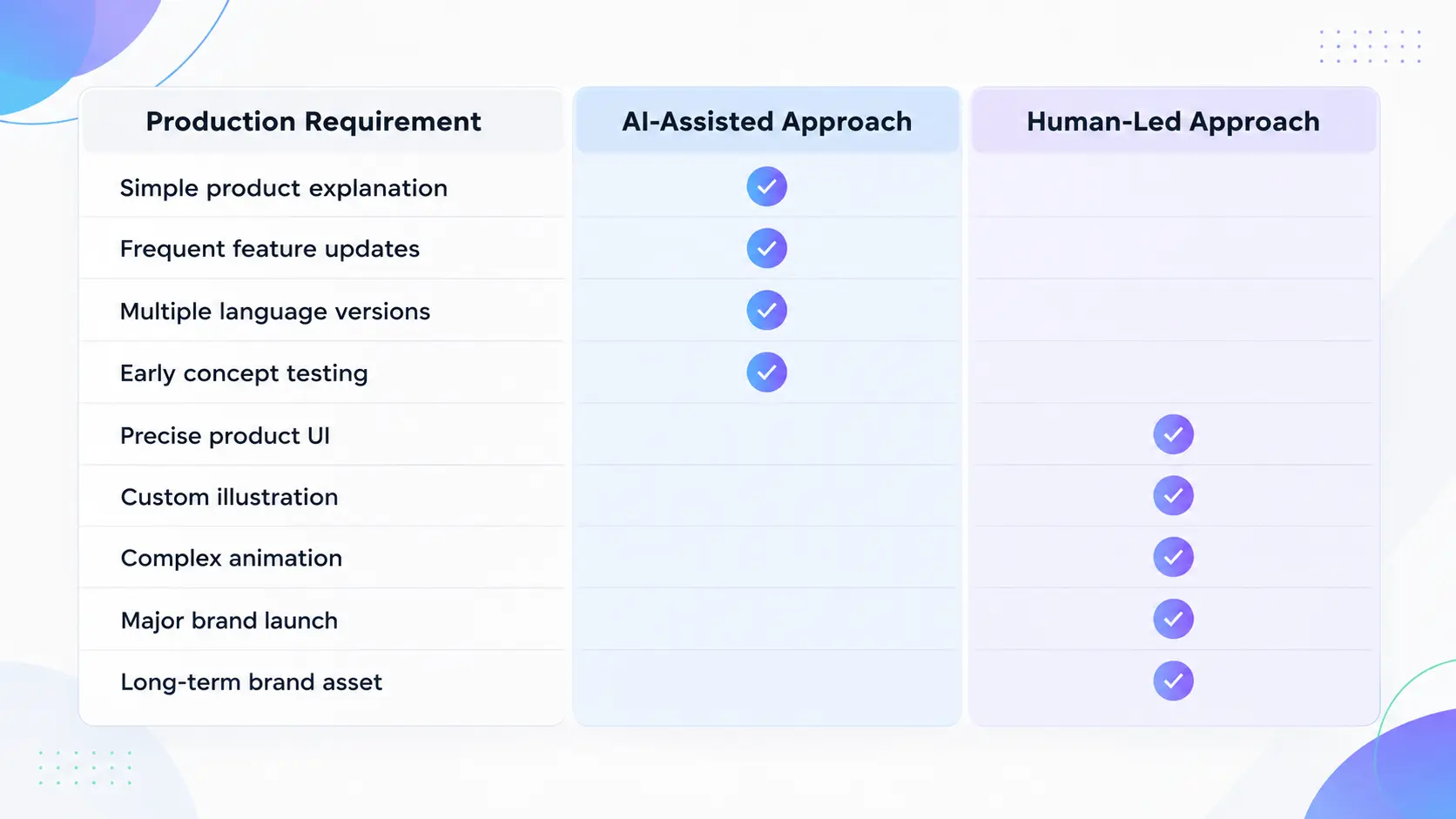
The right production approach depends on how much control and customization your video requires, from simple screen recordings to custom UI animation or a hybrid approach.
A Different Way to Approach Explainer Video Production
For many companies, the choice has traditionally been between producing a video internally or investing in a larger production.
AI-assisted production creates another option.
You can create an explainer video with a lower starting budget and a potentially shorter production timeline, depending on the requirements.
This can be particularly useful for startups and growing technology companies that need to explain products, features, and ideas without committing to a large production every time.
It can also make regular video production more practical when a company needs several explainers throughout the year.
Need an AI Explainer Video?
If you have considered an explainer video but the usual production cost or timeline has been a concern, an AI-assisted approach may be worth exploring.
What a Story offers AI-assisted explainer video production starting from $500 per video.
You can start with a single video or discuss a monthly plan if you need videos regularly.
Share your product, idea, or use case and what you want the video to explain. We can recommend a production approach based on your requirements.


