

.jpeg)
The Catalyst video has been such a hit - we are interested in releasing it in other languages.
Orbis Operations works with organizations across defense, intelligence, and national security.
It's Catalyst platform helps organizations share data across different systems, partners, and trust boundaries without giving up control of their data.
Instead of creating separate point-to-point connections between every partner, Catalyst provides a hub architecture that allows data to be routed, translated, and governed through a central connection point.
The product addresses a highly specific challenge: how can organizations share trusted data quickly while maintaining data sovereignty and avoiding vendor lock-in?
The Challenge
Making a complex defense technology understandable in 60 seconds
The project involved explaining a technical data-sharing problem to an audience that already understands the challenges of working across multiple systems and organizations.
As the number of partners increases, point-to-point integrations become increasingly difficult to manage.
For example:
- 5 partners = 10 connections
- 10 partners = 45 connections
- 20 partners = 190 connections
But integration complexity wasn't the only issue.
Organizations also need to maintain control over their data while sharing it across different trust boundaries. Existing approaches can create additional technical and policy friction, making data sharing slower than the mission requires.
The challenge for What a Story was to explain this architecture without turning the video into a technical presentation.
The audience needed to understand three things quickly:
- Why point-to-point integrations become difficult at scale.
- How Catalyst simplifies the architecture.
- How Catalyst allows organizations to share data while maintaining control.
The Creative Approach
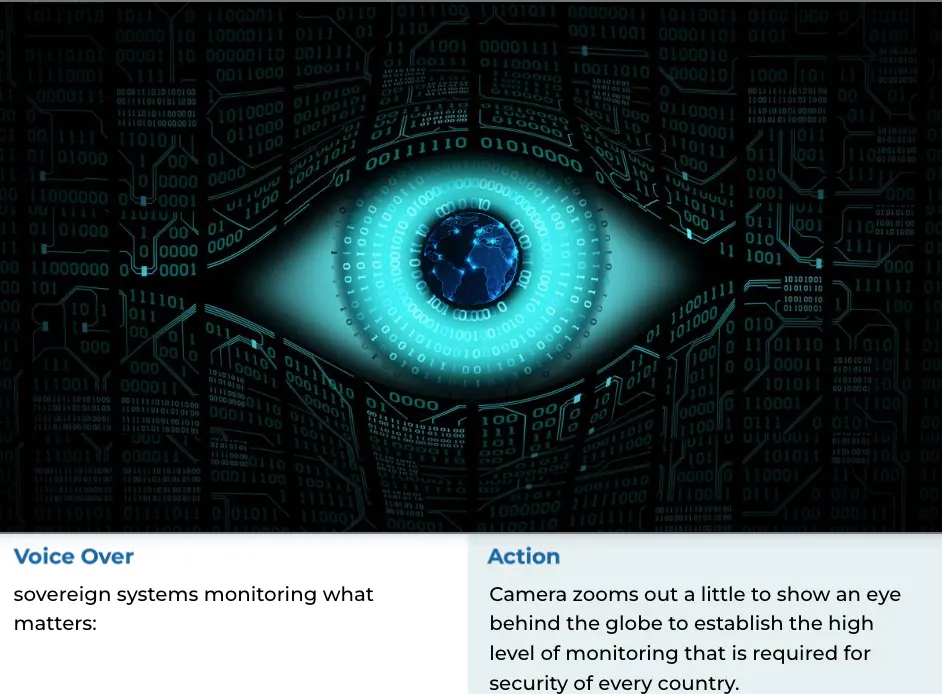
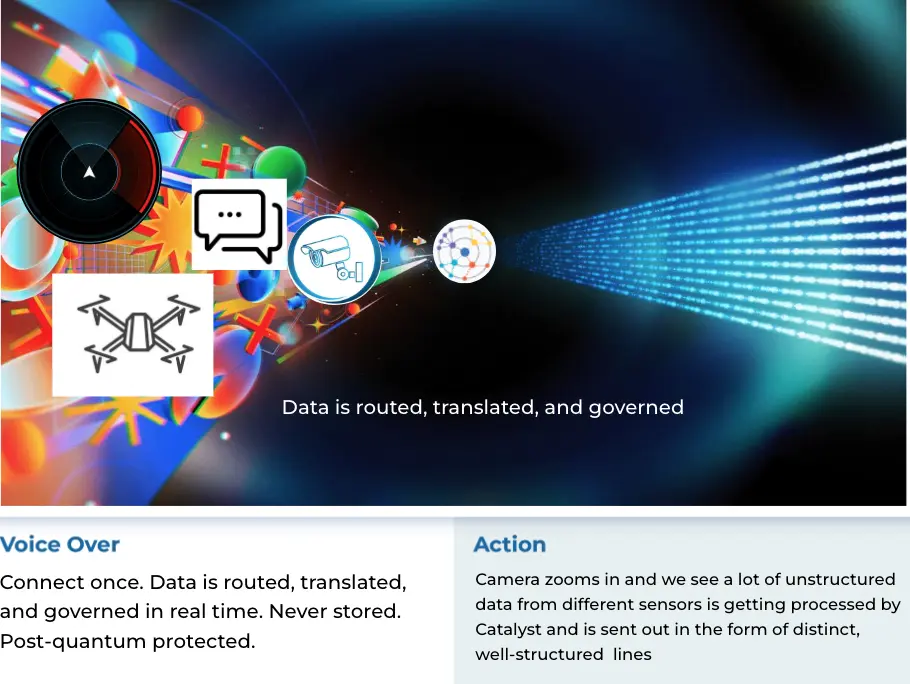
The creative direction was built around one simple visual idea:
Many connections → One hub
Instead of using generic defense imagery or starting with broad statements about data sharing, we focused on the specific problem Catalyst solves.
The story begins with multiple systems and partners attempting to communicate with one another. As more connections appear, the growing complexity becomes visible.
Catalyst is then introduced as the central connection point, changing the architecture from multiple individual integrations to a hub-based model.
This gave the video a straightforward narrative:
Integration Complexity → The Problem → Catalyst → Hub Architecture → Data Control → CTA
Visualizing integration complexity
One of the most important parts of the project was showing why point-to-point architecture becomes difficult as organizations add more partners.
Rather than relying only on voiceover to explain the numbers, the visual language was used to make the growing network of connections understandable.
The increasing number of connections creates a clear visual contrast with Catalyst's hub architecture.
This allowed the audience to understand the problem before the product was introduced.
Showing the Catalyst difference
Once the problem was established, the visual story shifted toward Catalyst.
The multiple individual connections were replaced by a central hub, giving the audience a simple representation of how Catalyst changes the way systems communicate.
This visual transformation became the central moment of the explainer.
It also helped communicate one of Catalyst's main benefits without requiring a lengthy technical explanation:
Organizations can connect through one architecture rather than building separate integrations for every partner.
Communicating data sovereignty
Data sovereignty was another important part of the brief.
Catalyst is positioned as a vendor-neutral solution that facilitates data sharing without taking ownership of the data itself.
We kept this idea within the visual narrative so it didn't feel like a separate technical feature.
The video communicates that:
- Organizations retain control over their data.
- Catalyst facilitates delivery between systems.
- Data can be routed and governed according to defined policies.
- Organizations aren't required to place their data inside another vendor's ecosystem.
This helped distinguish Catalyst from traditional integration approaches while keeping the explanation accessible to non-technical decision-makers.
Motion Design & Animation
The animation was designed around the product architecture rather than relying on decorative motion.
System connections, data movement, partner networks, and the Catalyst hub were brought together through motion to show how information moves between different environments.
The pacing was kept concise to fit the approximately 60-second runtime while allowing each major idea enough time to register.
The result was a technical product video that communicates the architecture visually instead of relying on long explanations.
The Result
The final 60-second explainer gives Catalyst a concise way to explain its data-sharing architecture to prospective customers and partners.
The video clearly establishes the problem, demonstrates the difference between point-to-point and hub-based architecture, and communicates Catalyst's focus on data sovereignty and vendor neutrality.
More importantly, the response from Orbis Operations provided direct validation of the work.
The client shared that the Catalyst video had been “such a hit” and was interested in releasing it in additional languages.
That response also opens up a wider use case for the video: adapting the same visual story for different markets and coalition partners.
Final Takeaway
Catalyst is a technically sophisticated product solving a problem that can be difficult to explain without getting into infrastructure, protocols, and policy.
The What a Story team reduced that complexity to a simple visual story: multiple disconnected systems, growing integration complexity, and a central hub designed to make data sharing easier to manage.
The client response showed that the final video communicated the product effectively enough to consider adapting it for additional languages.
Have a complex product that needs a clear explanation? Talk to What a Story about your next product explainer video.


