

I've sat in a lot of briefing rooms, a founder's office, a marketing team's open-plan floor with too many monitors and not enough whiteboards.
Some of them are Zoom calls where someone is sharing their screen and reading bullet points from a deck they've clearly been working on for weeks.
And in almost every one of those rooms, at some point, someone says a version of this:
"We want it to feel like a story. But we also need to cover these fourteen points."
The gap between what a brand thinks storytelling means and what it actually does is where most videos go wrong.
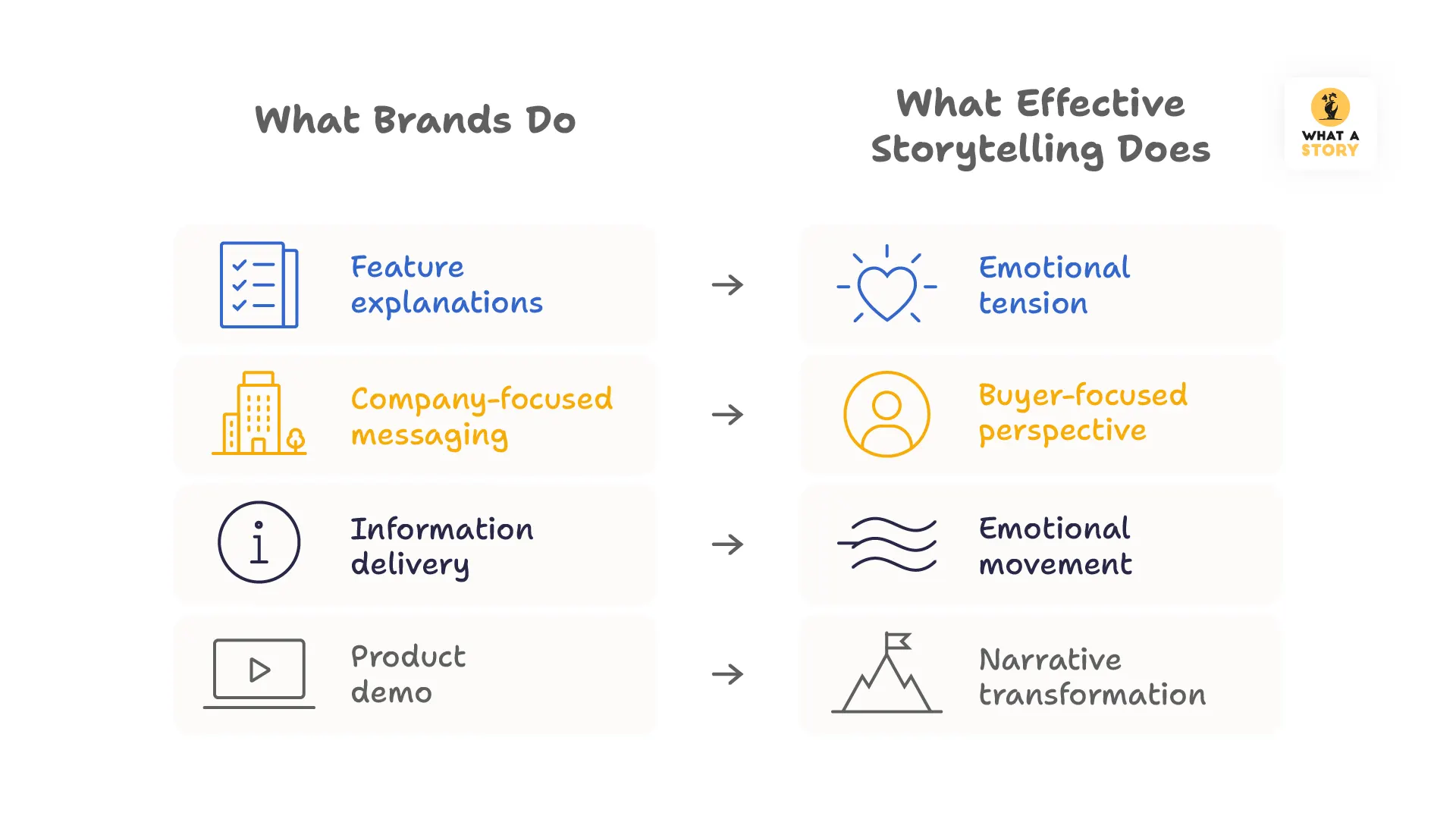
Most brand videos fail long before production begins. They fail at the level of narrative thinking. This is especially visible in product launch videos where companies try to communicate everything at once.
After working as a creative director at What a Story, I've developed some strong opinions about what brand storytelling in video actually is. And more usefully, what it isn't.
Here I take you through it all.
Let's Start With What It Isn't
Brand storytelling is not a narrative wrapper you put around your product features.
It is not a voiceover that says "once upon a time, businesses struggled with X" before pivoting to a feature list.
It is not a two-minute film about your company's values; the Concept in Practice ends with your logo and a tagline. It is not a customer testimonial stitched together with cinematic B-roll and an emotional music bed.
“Those things can be part of storytelling. They are not by themselves the story.” The word "story" is used so loosely in marketing that it has almost stopped meaning anything.
When a brand says "we want to tell our story," they usually mean one of two things: they want to talk about themselves, or they want to add an emotional quality to content that is fundamentally informational.
Neither of those is brand storytelling. And neither of them will make a viewer feel anything.
What Brand Storytelling Actually Does
Here is the most useful definition I've found, tested across more than a decade of production work:
Brand storytelling is the deliberate use of narrative structure to make a viewer feel something that makes them more likely to act.
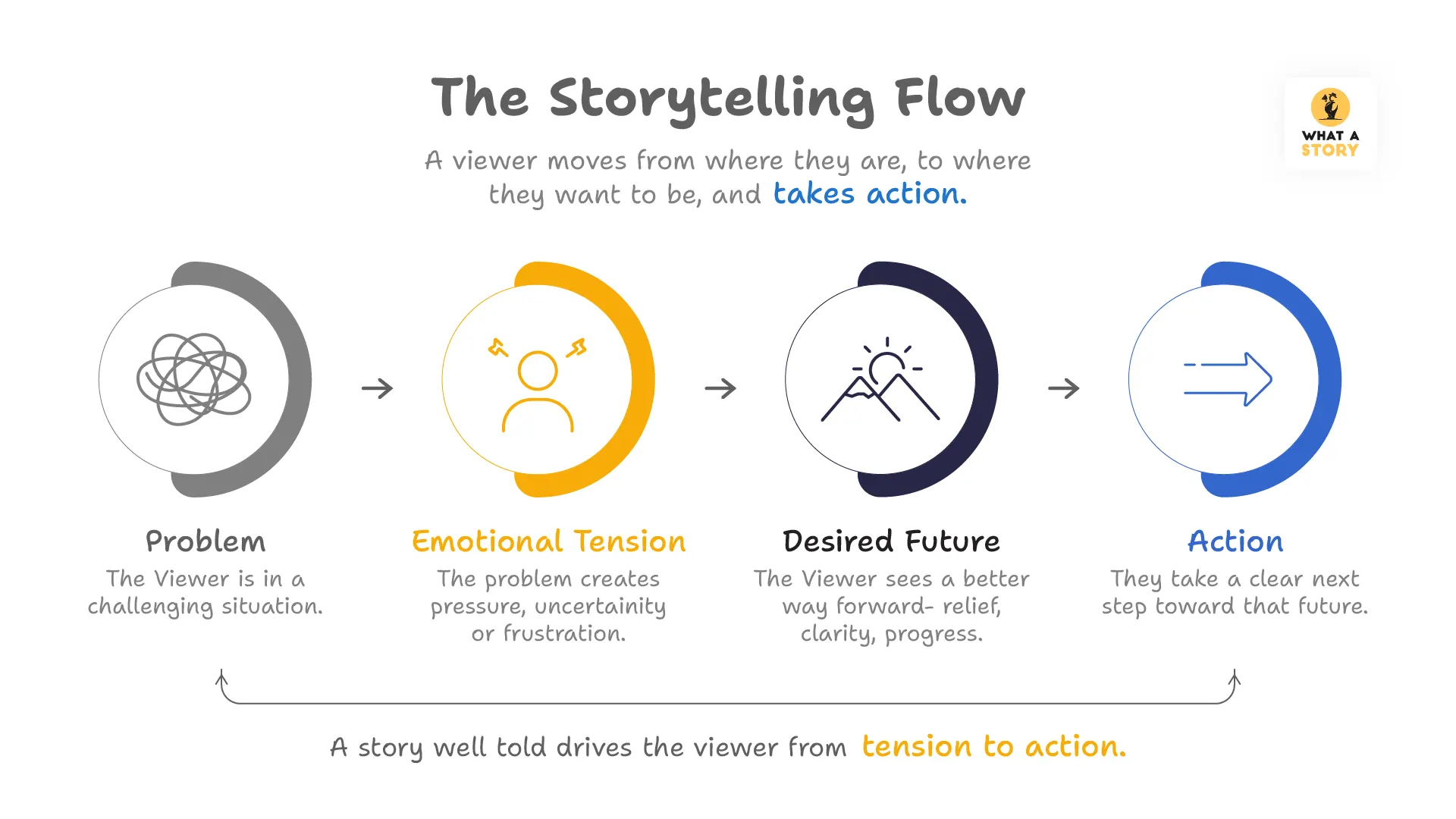
Every word in that definition matters.
Deliberate - It's engineered. Every creative decision be it the opening image, the pacing, the voice, the silence, the colour palette is in service of a specific emotional response.
Narrative structure - not just "a story," but the flow of tension and resolution that makes stories work. Something is wrong. Something must change. Something changes. And the viewer is emotionally involved in the gap between those three states.
The best storytelling across film, advertising, and brand communication relies on the same underlying principle: tension creates attention.
Feel something - not understand something. Not be informed about something. Feel something. Comprehension is the job of a spec sheet. Feeling is the job of a story.
More likely to act - because emotion without direction changes nothing. Brand storytelling is always in service of a business outcome. It's not art for art's sake. It's art in the service of a very specific ask.
"The purpose of storytelling in marketing is not emotional expression. It's reducing resistance to action."
The Architecture of a Brand Story
Good brand storytelling in video follows a structure that's as old as narrative itself but applied with precision to the specific context of a viewer who is skeptical, distracted and has twelve other tabs open.
The protagonist is not your brand. It's your buyer.
This idea closely mirrors the StoryBrand framework popularised by Donald Miller, where the customer is positioned as the hero and the brand as the guide.
We built this. We solved this. We're the ones who figured it out.
The viewer cares about their situation before they care about your brand. They care about the pressure they're under, the problem they're trying to solve, and what happens if they fail.
The moment you put your brand at the centre of the story, you've lost them. Because nobody cares about a story where they're not in it.
The brands that do this brilliantly place the viewer as the protagonist from frame one. They open on a situation the viewer recognises.
It’s not a generic "businesses struggle with X" situation, but a specific, textured, emotionally accurate version of the frustration the viewer lives with.
And then your brand enters not as the hero, but as the guide. The thing that helps the hero (your buyer) become the person they're trying to be.
This is the Yoda structure. Your buyer is Luke. Your brand is Yoda. The story isn't about Yoda. It's about Luke. Yoda just changes everything.
A Concept in Practice: The Problem Has to Hurt
We produced a video for a SaaS company in the revenue operations space. Their initial brief described their platform in impressive detail with integrations, automation capabilities, real-time dashboards.
The founding team was technically sophisticated and genuinely proud of what they'd built.
The first draft script opened like this:
"Managing revenue operations across disconnected tools is complex. [Product name] brings everything together in one place."
Technically accurate. Emotionally inert.
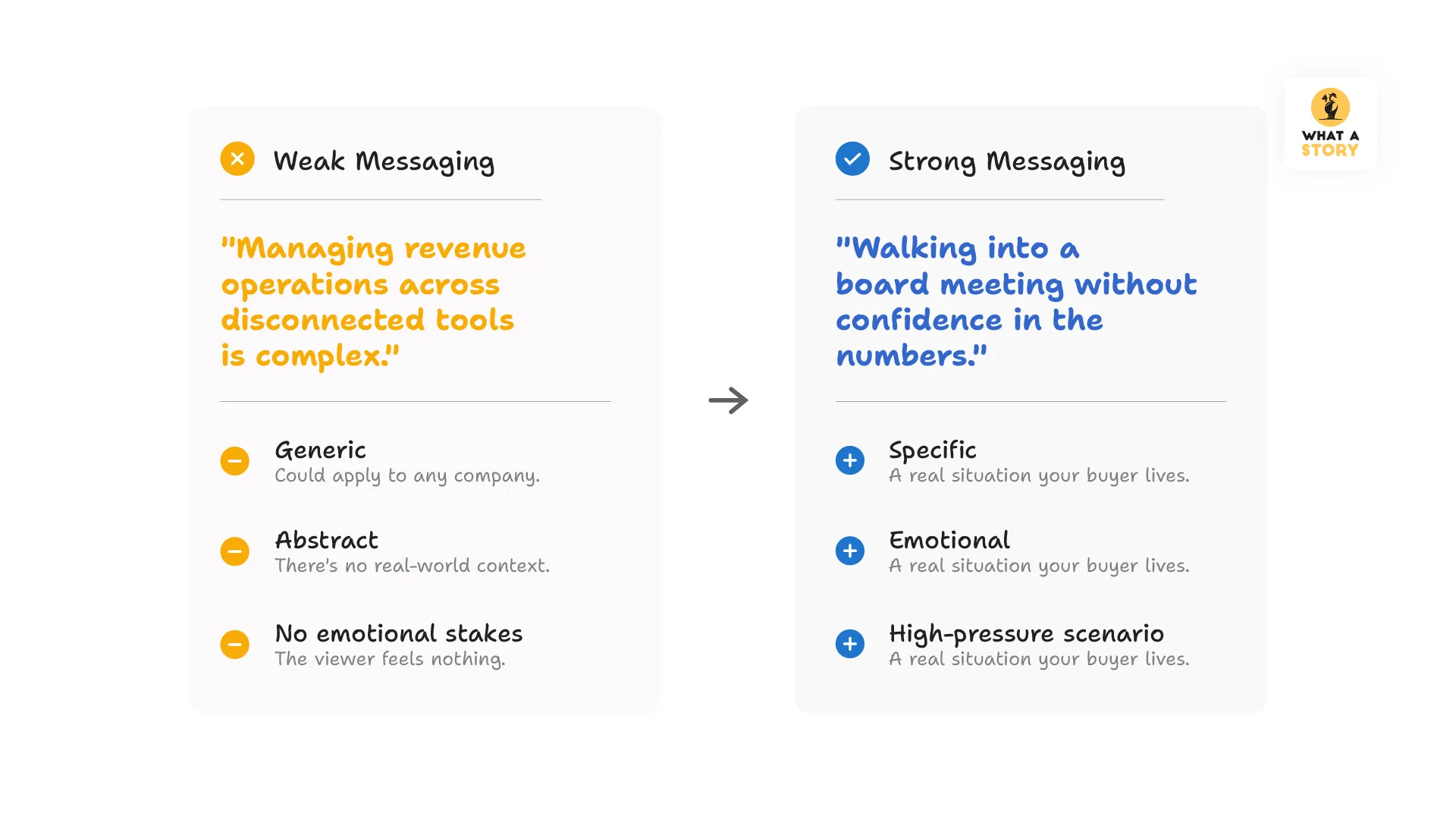
We pushed back. We asked: what does your buyer say to their manager on a Monday morning when something has gone wrong? What does the bad version of their week look like?
Those early discovery conversations often determine whether a video becomes emotionally accurate or just technically correct.
It turned out the real frustration wasn't disconnected tools. It was walking into a board meeting without confidence in the numbers.
Being asked about pipeline health and knowing the data might already be outdated. In B2B SaaS, those moments of operational pressure are often the real emotional core of the story.
That's a feeling. That's a story. And when we opened the video on that moment not on the product, not on the problem in the abstract, but on that specific texture of professional anxiety, it transformed.
The viewer didn't watch it and thought "this is a video about revenue operations software." They watched it and thought "that's me. That's my Monday."
That recognition is the hook of brand storytelling.
The Three Emotional Beats Every Brand Video Needs
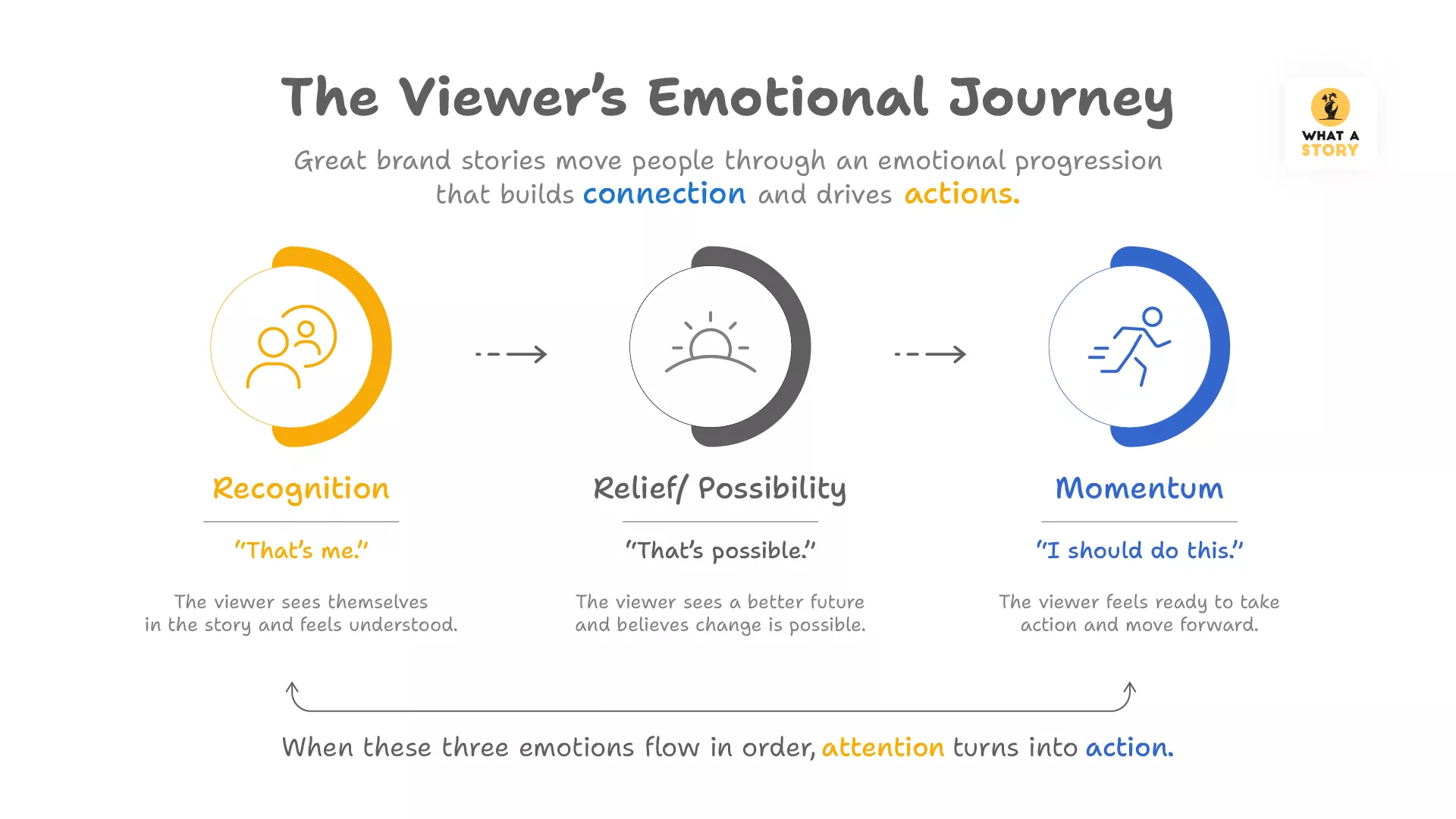
Across hundreds of productions, I've noticed that most effective brand videos move through the same emotional progression regardless of industry, format, or budget.
First, the viewer recognises themselves in the story. Not through generic pain points or broad marketing language, but through details that feel specific and emotionally accurate.
The moment a viewer thinks, 'Yes, that's exactly what this feels like,' you've earned their attention.
Then the story opens up a sense of possibility. The viewer begins to see a version of their world where the frustration, pressure, or uncertainty they've been carrying no longer defines the situation.
This is where desire starts to build.
And finally, the viewer needs a sense of movement. A clear next step. A feeling that solving this problem is not only possible, but achievable. The same principle applies to SaaS onboarding where visual momentum often determines whether users continue or drop off.
The purpose of storytelling in marketing is not emotional expression. It's reducing resistance to action.
Most brand videos lose momentum in the middle. They shift too quickly from emotional tension into product explanation and forget they're still shaping a feeling, not just delivering information.
And many never properly close the story at all. They fade to a logo and assume the viewer will figure out what to do next.
They won't. The story has to be resolved.
Video Is the Strongest Medium for Brand Storytelling!
You can tell a story in text. You can tell a story in audio. But video is the only medium that controls time, image, sound, and motion simultaneously which means it's the only medium that can engineer an emotional experience with that level of precision.
The pacing of a cut creates urgency or calm. The warmth of a colour palette creates trust or energy. The texture of a voiceover creates intimacy or authority.
The moment of silence before a key line creates weight that no other medium can manufacture.
In our production work, we think about these elements as emotional levers and every creative decision in a video is really a decision about emotional emphasis and timing.
The pacing of the edit determines how much processing time the viewer has for each idea before the next one arrives.
This is why brand storytelling in video requires a different discipline than brand storytelling in other media. The decisions compound.
A slightly wrong colour palette on top of a slightly too-fast edit on top of a slightly miscast voiceover produces a video that feels subtly off in a way the viewer can't articulate but that they feel as a lack of trust.
And a viewer who doesn't trust the video doesn't trust the brand behind it.
The Mistake That Kills Most Brand Videos
The most common thing I see in briefs across every industry, every company size, every budget is a list of things the brand wants to communicate.
Not a feeling they want the viewer to have. Not a belief they want to create. Not a version of the viewer's world they want to make visible. A list of points.
“Brand storytelling is not the delivery vehicle for your list of points. It is the replacement for your list of points.”
A viewer who finishes a brand video thinking "I understood what that product does" has been informed.
A viewer who finishes a brand video thinking "I need that. I'm not sure I can manage without it" has been moved. Those are different states. And only the second one reliably produces action.
The brief that produces the first state says: "We need to communicate these five things about our product."
The brief that produces the second state says: "We need our viewer to feel _______ and then we need them to _______ ."
Filling in those blanks honestly with the specific emotion and the specific action is the hardest part of building a brand story.
It's also the most important part. And it's the part that happens before a single frame is designed, before a word of voiceover is written, before any of the craft that makes a video work.