

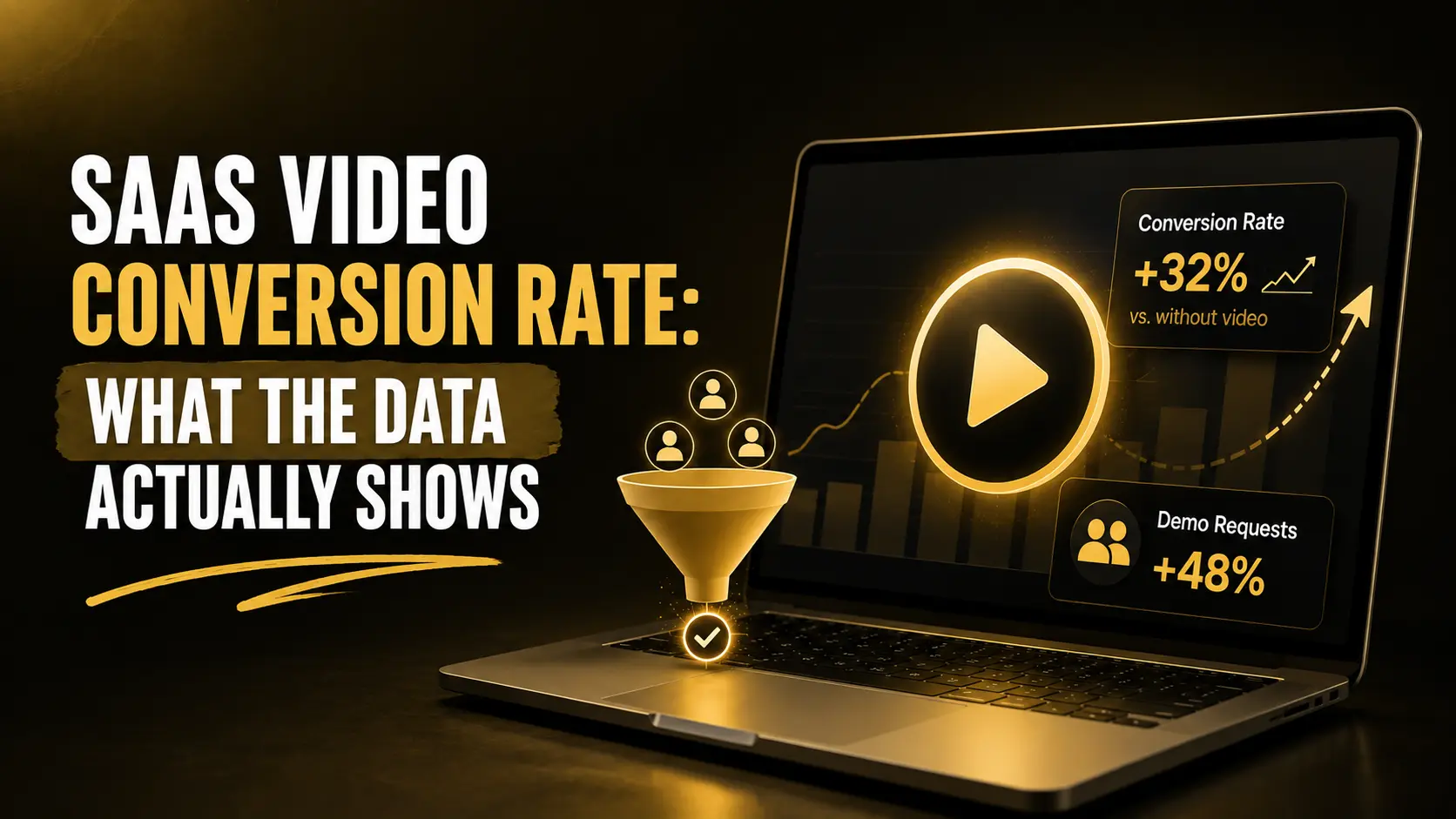
A data-backed analysis of SaaS video conversion, viewer behavior, CTA performance, and what actually influences signups and demos.
A SaaS video does not have one standard conversion rate.
A 16% video CTA conversion rate, a 4% landing-page conversion rate, and a 30% increase in demo requests can all be legitimate numbers - but they measure different things.
That distinction matters because many SaaS video reports combine viewer engagement, CTA clicks, leads, signups, and customers under one metric called “conversion.”
This analysis separates them.
It combines What a Story's analysis of 1,000+ SaaS videos and its performance data with independent research from Wistia, Vidyard, Unbounce, and other sources to understand where video contributes to SaaS conversion and where the evidence is still limited.
What Is A SaaS Video Conversion Rate?
For a SaaS company, video conversion can happen at several points:
These numbers should not be treated as interchangeable.
For example, if 10,000 people visit a SaaS page, 2,000 watch the video, and 100 request a demo:
- Page-to-demo conversion = 1%
- Video-viewer-to-demo conversion = 5%
Both are correct. They simply answer different questions.
What The Data Says About SaaS Video Conversion Rates
There is no single benchmark for SaaS video conversion. The available research measures different actions, from video CTA clicks to landing-page conversions and actual demo requests, so these figures should not be treated as interchangeable.
Key data points
- 16% - Average video CTA conversion rate reported by Wistia across more than 36,000 video CTAs.
- 3.8% - Median SaaS landing-page conversion rate reported by Unbounce, based on more than 464 million visitors and 57 million conversions.
- 82% - Share of What a Story's free-trial CTA videos that were under 60 seconds.
- 64% - Share of What a Story's demo-CTA videos that were over 90 seconds.
- 14%–78% - Observed increase in demo requests across What a Story projects where performance data was available.
- 32% - Median demo-request lift observed in the first quarter across those reported outcomes.
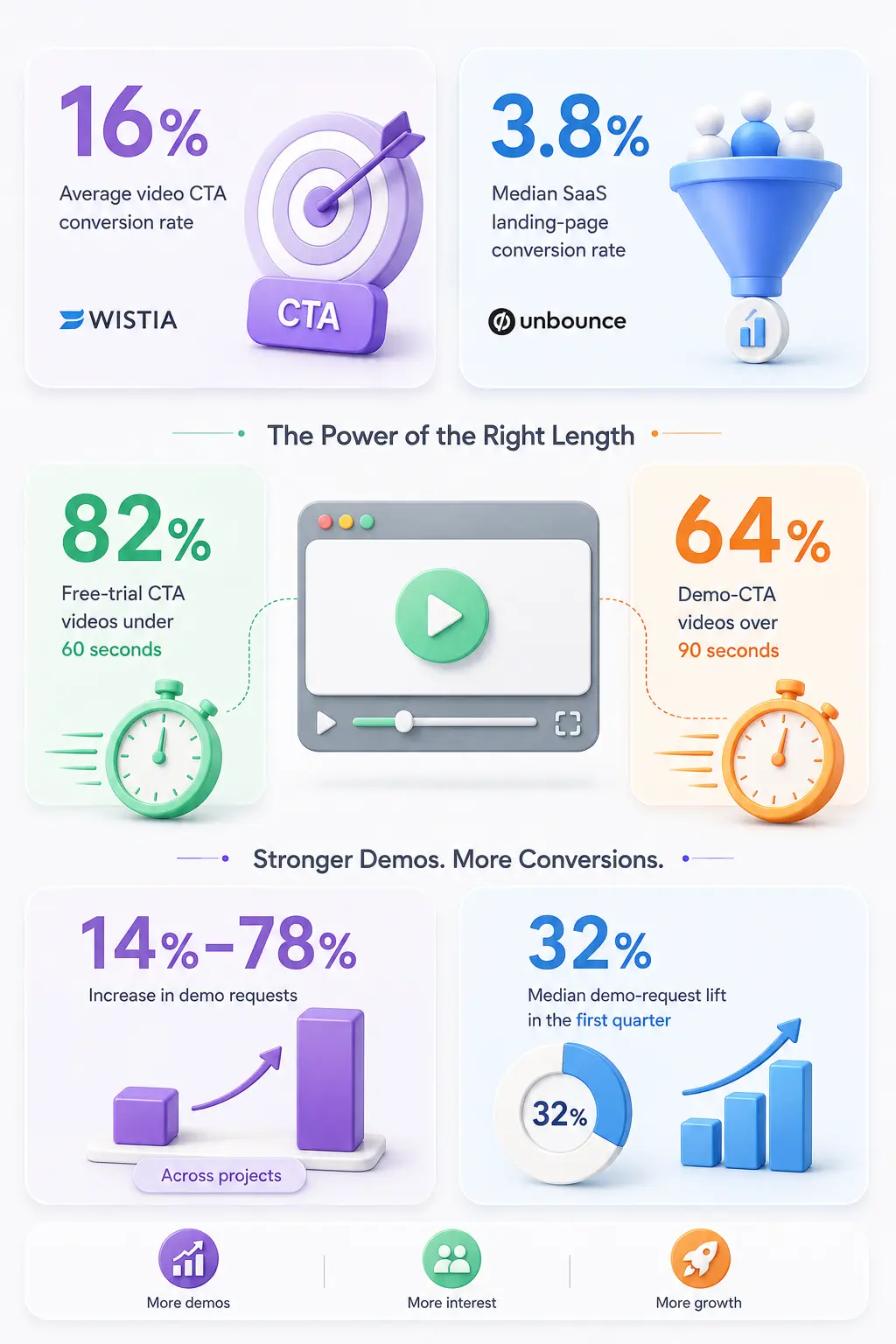
These numbers measure different things. Wistia's 16% is a video CTA conversion rate, Unbounce's 3.8% is a landing-page conversion benchmark, and What a Story's figures are observed client outcomes. They should therefore not be combined into an average SaaS video conversion rate.
The more useful conclusion is that video conversion depends on what action is being measured, where the video appears, and what the viewer is being asked to do next.
Video Does Not Automatically Increase Conversion
This is where the broader research becomes important.
Adding a video to a landing page is not enough.
Unbounce has reported mixed results from large-scale landing-page analysis, while individual controlled experiments have produced substantial lifts.
One Unbounce/Vidyard test compared three versions of a landing page:
The embedded version produced a 69% relative increase, while the lightbox version produced a 100% relative increase against the control.
This is useful evidence that video can influence conversion.
But it is still a specific experiment.
It should not be converted into: “Video increases SaaS conversion by 100%.”
That claim would go beyond the evidence.
Why Some SaaS Videos Convert and Others Don't
Adding a video to a SaaS page does not automatically improve conversion. The result depends on whether the video helps the right visitor understand the product and move toward the intended action.
Four factors have the biggest impact.
1. Match the video to the buying stage
Different visitors need different information.
A first-time visitor may need to understand the problem and what the product does. A returning visitor may want to see the product in action. A sales-ready prospect may need a more detailed demonstration before booking a call.
The same video is unlikely to work equally well for all three audiences.
2. Answer the question the visitor has
Before converting, a SaaS visitor usually needs answers to a few basic questions:
- What does this product do?
- Can it solve my problem?
- How does it work?
- Why should I choose it?
- What should I do next?
A video that answers these questions quickly can reduce uncertainty. A video that starts with company history, generic claims, or unnecessary detail may delay the information the visitor actually needs.
This is also reflected in What a Story's analysis: 72% of TOFU videos use a problem-led opening, while 81% of mid-funnel and retargeting videos open with the product or UI.
3. Match the CTA to the level of intent
The action you ask for should make sense for the amount of information the viewer has received.
A visitor who is ready to explore the product may be suitable for a free-trial CTA. Someone evaluating an enterprise SaaS product may need more information before being asked to book a demo.
What a Story's data shows this difference clearly:
- 82% of free-trial CTA videos are under 60 seconds
- 64% of demo-CTA videos are over 90 seconds
The point is not that short videos convert better. It is that the amount of explanation should match the commitment you're asking the viewer to make.
4. Get to the action before the viewer leaves
A video only has a conversion opportunity if the viewer reaches the point where the CTA appears.
Long introductions, unnecessary product details, or slow explanations can cause viewers to leave before they reach the action.
Vidyard's B2B video data shows that shorter videos generally have higher completion rates than longer videos. That does not mean every SaaS video should be short. It means the opening needs to establish relevance quickly and the video should avoid adding information that does not help the viewer make the next decision.
The goal is simple: give the viewer enough information to take the next step, without making them work through information they don't need.
A Video Viewer Is Not Automatically a Qualified Lead
A video view is an engagement signal. It is not a business outcome.
Consider a SaaS landing page with 10,000 visitors. If 2,500 watch the video, 400 click the CTA, and 100 submit a demo form, the funnel looks very different at each stage:
10,000 visitors → 2,500 viewers → 400 CTA clicks → 100 leads
That means the video generated a 16% viewer-to-CTA rate, but only a 4% viewer-to-lead rate.
Both numbers are useful. They simply answer different questions.
The mistake is treating a CTA click as a conversion and assuming every viewer has the same level of buying intent. For SaaS teams, the real question is not How many people interacted with the video? but Did the video move more qualified prospects toward a commercial action?
Measure The Funnel, Not Just the Video
A conversion-focused video should be measured as part of the customer journey.
Start with play rate to understand whether the video earns attention. Then look at engagement to see whether viewers stay long enough to absorb the message. CTA clicks show intent, but leads, qualified opportunities, and revenue show business impact.
The measurement should therefore progress from:
Views → Engagement → CTA clicks → Leads → Qualified opportunities → Revenue
For B2B SaaS, the later stages matter most.
A video that generates fewer clicks but produces better-qualified demo requests can be significantly more valuable than one that produces thousands of low-intent interactions.
Don't Confuse Correlation With Causation
This is where many video conversion reports become misleading.
Imagine that 6% of video viewers convert, compared with 3% of visitors who do not watch the video.
It is tempting to say the video doubled conversion.
But viewers may already be more interested in the product. They may have spent longer on the page, explored pricing, returned to the site, or arrived with stronger purchase intent.
In other words, the people who watched the video may have been more likely to convert anyway.
That makes viewer vs. non-viewer comparisons useful for analysis—but not strong enough to prove that the video caused the lift.
The Stronger Measure: Incremental Conversion Lift
The cleanest way to understand video impact is to test it.
Create two versions of the same SaaS landing page:
Control: No video
Variant: Video included
Keep the rest of the experience as consistent as possible, then compare outcomes such as demo requests, free-trial signups, qualified leads, opportunities, and revenue.
For example:
Control: 3.5% demo conversion
Video variant: 4.8% demo conversion
That represents a 1.3 percentage-point increase, or roughly a 37% relative lift, assuming the result is statistically reliable.
Now you have a much stronger basis for saying the video contributed to the improvement.
What The Combined Data Tells Us
When the What a Story research is placed alongside external datasets, several patterns become clearer.
Finding 1: There is no single SaaS video conversion rate
Video CTA conversion, landing-page conversion, signup conversion, and customer conversion are separate metrics.
Finding 2: Video can improve conversion, but the effect varies
What a Story's client data shows measurable lifts in demos, signups, and landing-page conversion, while independent experiments also show significant improvements in specific contexts.
Finding 3: The CTA should determine the video strategy
Shorter videos dominate free-trial CTA use, while longer videos are more common when the goal is a demo.
Finding 4: Funnel stage changes the opening
Problem-led openings dominate TOFU explainers, while product/UI-first openings are much more common in mid-funnel and retargeting content.
Finding 5: Retention is not conversion
A viewer watching 90% of a video does not automatically become a lead.
The video must connect attention to a relevant next action.
The Real Question Isn't Does Video Convert?
The better question is: Where does video create enough additional understanding to change the next action?
For a complex SaaS product, that could mean helping a visitor understand the product well enough to start a trial.
For an enterprise product, it could mean helping a prospect understand the workflow well enough to book a demo.
For an existing lead, it could mean removing a product objection before a sales call.
The conversion event changes because the buyer's information requirement changes.
Final Takeaway
SaaS video conversion is not determined by video alone. The result depends on who watches it, where it appears, what it explains, and what action follows.
The most reliable approach is to treat video as part of the conversion path, then measure whether it creates a measurable improvement in the next business action.
The goal is not more video views. It is more qualified actions that contribute to pipeline and revenue.
Data Source:
https://www.whatastory.agency/resources/saas-explainer-video-analysis
https://www.whatastory.agency/resources/saas-video-production-stats
https://wistia.com/blog/video-marketing-statistics
https://unbounce.com/landing-pages/whats-a-good-conversion-rate/